The message asked that she review relevant details by clicking a link.
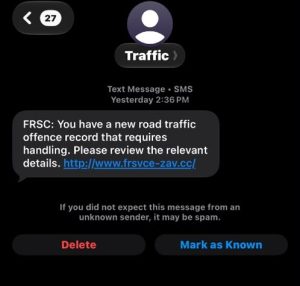
She paused for a second and wondered why she received this message, knowing she doesn’t own a car.
“I laughed and wondered why I should click the link when I don’t even own a car. It is clearly bizarre,” she told ROUNDCHECK.
ROUNDCHECK observed that many Nigerians also received this link; While Zaynab was able to decipher that it was a scam, others fell victim, losing millions of naira.
Nigerian comedian, Edeh Chisom, popularly called MC Monica, said he fell victim to the FRSC scam. According to him, he proceeded to pay a #5000 after receiving the text message, and what followed was a deduction of over a ‘million naira (#1,849,378)’ from his account.
Also, Actor Adekanla Desalu said he lost $2,500 after paying #2,500 through the FRSC scam link.
Although the FRSC debunked the claim days later, the impact had already been felt.
The FRSC noted that the scam message was designed to impersonate the digital identity of the Federal Road Safety Corps. “The Corps therefore unequivocally disowns the messages and the website, stressing that members of the public should not regard such communications as originating from FRSC,” the agency said.
Scammers continue to target unsuspecting members of the public using phishing links combined with emotionally crafted messages. In some cases, these messages are crafted around people’s day-to-day activities, making them appear credible and increasing the likelihood of victims falling for the scams.
How Did The FRSC Scam Work?
Members of the public received several text messages on their phones purportedly from FRSC, a regulatory agency responsible for the administration of traffic laws and regulations in Nigeria.
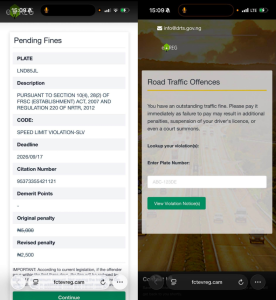
The messages informed recipients of a traffic offence and asked them to click a link to view details. The tactic was to take them to a separate website where they would be required to pay and fill in some details.
ROUNDCHECK observed that the website links received by recipients differ. Some of the links are www.fctevreg.cam/z, www.frsvce-zac.cc, www.frscc-zgh.cc, and are no longer accessible.
How Not To Fall Victim To Online Scams
Online scams are targeted at Susceptible members of the public, using relatable messages and emotion-driven statements to steal their personal information, money, and, in some extreme cases, cause harm to them.
Sometimes, they pose as recognised government agencies or institutions that members of the public interact with. To be safe, ROUNDCHECK has provided practical ways not to fall victim to these scams, just like the FRSC messages received by several Nigerians.
1) Don’t be forced to click; read again: The first thing that comes to mind when you see a message that speaks to your emotions is for you to click. Resist the urge to, and take your time to read again. Read the message again carefully to understand the context, the sender, and why you should be receiving that message. Bad actors will want you to click a scam message that has been crafted to appear emotional to you; do not click. Read it again, and again. One click can cause a lot of damage and expose you to risk.
2) Check the sender of the message and other information in it: Critically examine the sender of the message and other information included in it. This could include the name of the institution (Is it correctly written?), or even the website link attached in the message (Is this the verified website address of the organisation?). Check for errors in the sentences and use of punctuation. A recognised institution is unlikely to make sentence errors in its official messaging. Asking these questions can help protect you from getting scammed.
3) Conduct a keyword search: A keyword search on Google can reveal a lot of information about the message you’ve received. In the case of the FRSC message, a keyword search would be “ FRSC traffic offence link” or “FRSC traffic offence” or “FRSC traffic offence payment”. This will reveal the original website of the FRSC, traffic offence link, if any, and other related information of the FRSC that can help you make a decision.
4) Check the website domain: Most scam websites try to replicate the websites of an authentic organisation; however, some of the details are always different. Details like the URL spelling and the domain name are false if you check closely. Most authentic organisations will use familiar domain names like .com, .com.ng, .org.ng, .org, while government agencies in Nigeria use .gov.ng. It is important you check the spelling of these websites’ URLs and cross-check the domain.
5) Check reputable platforms: Checking through reputable platforms – including media organisations and social media – can help you know if the message or information is authentic. When you see a message telling you to click a link or promise financial rewards, your next step should be to check reputable news platforms and also verified social media handles of the organisation to confirm if the information is authentic.
6) Reach out to experts to confirm: When in doubt or uncertain about information you receive, your next step will be to reach out to experts who can help confirm if the information you’re about to act on is authentic. Experts could include fact-checking organisations (Like ROUNDCHECK), the contact number of the organisation, a financial expert, amongst others. Don’t make a decision based on half knowledge.
Conclusion
Online scams promise financial rewards for little or no effort, and most times are fuelled by emotionally charged messages. Checking a website or information thoroughly before acting on it will save you from getting scammed, data loss, and exposing yourself to danger.
]]>Following the 2026 Osun State governorship election, messages claiming that residents can receive 15,000 naira as a cash reward to celebrate Governor Ademola Adeleke’s election victory are circulating online.
The messages are designed to attract attention with the promise of quick and easy money. One version claims the reward is being offered by Governor Adeleke and is “powered by” Nigerian musician Davido. It further encourages recipients to click a link and claim the money.
One example reads:
“15,000 naira cash Transfer Governor Ademola Adeleke’s Celebrating Osun state ELECTION Victory NOW! with the sum of ₦15,000. POWERED BY: Davido. I just got my Now. Click below to get yours.”
The message directs users to https://celebration.davidocollaborate.forum for celebration.
Why Should You Be Concerned?
The biggest warning sign is the promise of an unexpected cash reward through an unfamiliar website.
A legitimate government cash-transfer programme would normally be announced through verifiable official channels, such as the relevant government website, official social media accounts or recognised government communication platforms.
The use of a politician’s name does not automatically make a message genuine. Likewise, mentioning a celebrity such as Davido does not prove that the celebrity is associated with the offer.
The link itself should also raise questions. A website address containing a person’s name or a generic phrase does not establish that it is an official platform of the Osun State Government.
What Could Happen If You Click?
Not every suspicious link will necessarily cause harm, but unfamiliar reward links can lead users to websites designed to collect personal information or deceive them into taking further actions.
A user may be asked to provide details such as a phone number, email address, bank information, card details, passwords or one-time passwords (OTPs).
Such information can potentially be exploited for fraudulent activities.
Some deceptive reward schemes may also encourage users to forward the link to friends or WhatsApp groups before they can supposedly claim their reward. This helps the misleading message spread rapidly.
How Can You Verify Such Claims?
Before clicking on a link promising election-related rewards, ask three simple questions:
Who is offering the money?
Look for an official announcement from the organisation or government body supposedly responsible for the payment.
Where was the announcement published?
Check verified official channels rather than relying on forwarded messages, screenshots or claims from unknown accounts.
Where does the link lead?
Be cautious when the website address does not clearly correspond to the official organisation being mentioned.
Most importantly, never provide your bank PIN, OTP, password or other sensitive financial information simply because a website promises you money.
The 15,000 naira should not be the reason you stop thinking
The appeal of instant cash can make people act quickly. That is precisely why reward-based misinformation can be effective.
The lesson from the circulating Osun election message is simple: a claim becomes less credible because it promises money.
If you receive a message promising 15,000 naira or any other election-related reward, do not click immediately, do not enter your personal information and do not forward it until you have independently verified the claim through official sources.
When the reward looks too easy, verify before you click.
Verdict
The circulating message and image claiming that Osun State Governor Ademola Adeleke is sharing 15,000 naira through Nigerian musician Davido is INCORRECT.
The message is aimed at harvesting individuals’ personal details.
]]>
OPay is a financial technology company operating primarily in Nigeria, focused on providing accessible and affordable digital financial services.
It was established in 2018 as part of Opera’s expansion into emerging markets, under the parent company Opera Limited. Since its launch, OPay has grown rapidly, becoming one of the most widely used mobile money platforms in the country.
ROUNDCHECK investigated this claim to determine whether this bonus is from the Fintech company.
ROUNDCHECK Findings
When ROUNDCHECK accessed the link, we saw a pop-up message claiming we are eligible for a ₦10,000 Easter bonus and requested our OPay account details.
After submission, we were then redirected to another website, claiming that 32,049 customers have already received the bonus, while our status remains ‘pending’ until a supposed withdrawal process is completed. ROUNDCHECK observed several comments underneath the website post claiming the bonus is real.

To verify if this is true, we first subjected the links attached to the claims to different verification platforms.
Using ‘e.Veritas,’ a web link verification tool, we found that all three links recorded a very low safety score of 10/100, indicating potential risks such as phishing, malware, blacklisting, or unsafe redirects.

Further checks with ScamAdviser revealed additional concerns. The first link, (vreeoffre.com/easter-bonus) was flagged as likely unsafe, with a trust score of 30/100, based on multiple red flags.

The second link, (ebekpone.com/get-easter-bonus), performed even worse, earning a 25/100 trust score, suggesting a high risk to users.

The inclusion of fabricated testimonials, such as a comment by ‘Joseph Emmanuel’ claiming to have received the money, serves as fake social proof to build trust and urgency.
Notably, a review of OPay’s official newsroom shows no record of any such promotion.
Moreover, the instruction to submit account details through external links is a clear red flag, as legitimate financial institutions do not request sensitive information in this manner.
Also, none of the links provided for the Easter bonus were not linked or associated with Opay, neither does it lead to OPay’s website.
Verdict
The claim that OPay is giving out a ₦10,000 Easter bonus through unverified links is INCORRECT. It is a hoax, designed to collect details of unsuspecting internet users.
]]>Claim
A circulating post on Whatsapp has claimed that there is a laptop giveaway application for students. The post also noted that “960,000 students will be given free laptop” to enhance their learning.
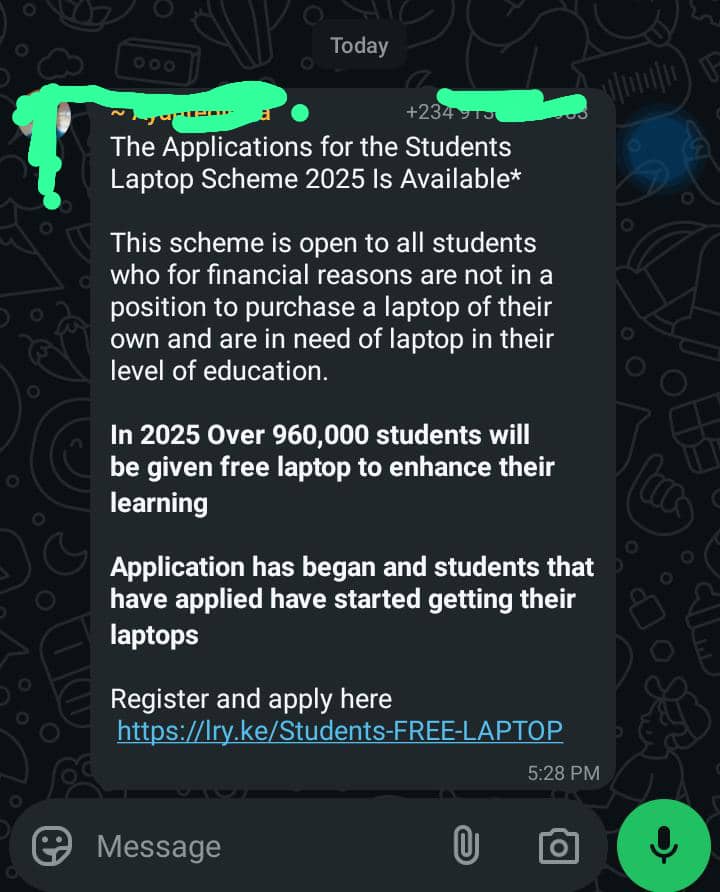
Due to the nature of the claim and its potential to steal personal information of Nigerian students, RONDCHECK took a deeper look.
ROUNDCHECK Findings
ROUNDCHECK visited the website and followed the step-by-step processes to verify the authenticity of the claim.
The first noticeable danger sign was the continuous increase in the number of shares, likes, and comments.
Within a minute, the number of likes, comments and shares rose to over two thousand and kept on increasing.
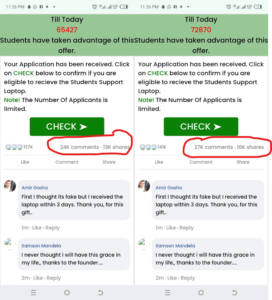
Another red flag noticed was the instruction to share with 5 groups before one would receive the selected package.
To further verify if the website is authentic, we subjected it to Scamadviser, a verification tool used to verify the credibility of websites. We noticed that the application link is linked to a server that has hosted several unreliable websites.
Also, Scam Adviser graded the website 40%, meaning that the website has common features associated with scams, indicating the need to be cautious of it.
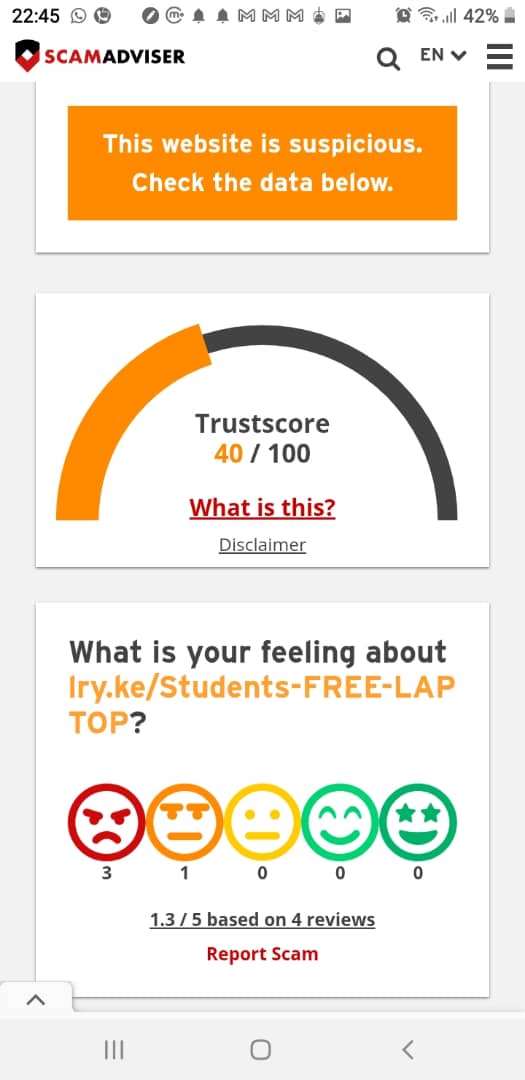
Furthermore, ROUNDCHECK discovered that the government or its agencies have not rolled out this scheme; there is no official organisation, ministry or individual attached as the sponsor or facilitator of this scheme.
Verdict
The circulating post claiming that there is an ongoing application for the students Laptop Scheme is FAKE.
It is a hoax created to deceive unsuspecting members of the public and illegally obtain their sensitive details.
How To Detect Hoax
To detect a hoax, individuals should watch out for messages that offer something unusually free, often presented as part of a scheme celebrating a person or event. These messages typically encourage recipients to take further steps to claim the supposed benefits.
However, when an individual comes across such messages, they should:
- Approach the information with scepticism.
- Research the person, event, or organisation mentioned to confirm whether the message is genuinely from them.
- Use website verification tools such as ScamAdviser to check the authenticity of the message or link.
This report was done under the Roundcheck Volunteer Network 4th Cohort
]]>There is a message circulating on WhatsApp claiming that the Niger Delta Development Commission (NDDC) has started a monthly stipend payment of 50,000 naira.

Through the link, Nigerian youths are told to submit their account numbers for payment through the suspicious link (https://Nddc-payment.inspireyouth. dotlive).
ROUNDCHECK investigated this claim and found it to be incorrect.
NDDC In Brief
The Niger Delta Development Commission (NDDC) was established in Nigeria in 2000 to promote sustainable development in Nigeria’s oil-rich Niger Delta region.
According to its website, its primary functions include infrastructure development, environmental protection, human capital development, and economic empowerment.
The commission aims to improve living conditions by addressing pollution, unemployment, and underdevelopment.
ROUNDCHECK Findings
Using the verification tool EASYDMARC, we assessed that the risk level associated with the link is high, indicating critical vulnerabilities in Sun Protection Factors (SPF), DomainKeys Identified Mail (DKIM), and Domain-based Message Authentication, Reporting and Conformance (DMARC).
EASYDMARC warned that these challenges greatly increase the risk of email impersonation and phishing attacks, emphasizing the urgent need to reinforce security measures.

Additionally, our analysis with another tool, e.Veritas revealed that the website contains warnings and exhibits characteristics that could pose risks.
E.Veritas advised users to navigate such sites cautiously, as they could result in unforeseen or unfavourable consequences.

Furthermore, using SCAMADVISER, we found out that the link has a very low trust score, indicating a strong likelihood that the website is a scam.
Hence, users and visitors to this link should be careful when interacting with this website- it is not safe.

When we clicked on the link, a notification appeared, stating: “NDDC: Payment ongoing. You are among the shortlisted candidates to receive a ₦50,000.00 monthly stipend. Kindly press ‘OK’ to submit your account number now.”

We checked the official NDDC website and found no updates regarding a monthly stipend of ₦50,000.
Moreover, no mainstream media has reported that the NDDC is offering a monthly stipend payment of ₦50,000. We also discovered that the link is not related to the official NDDC website.
The NDDC being a Nigerian government agency has its website ending with .gov.ng. Meanwhile, this malicious website has a hyphen (-) in between and multiple dots (.) in the link.
Verdict
The claim that the NDDC is providing a monthly stipend of ₦50,000 is INCORRECT.
]]>A viral post circulating on WhatsApp claims that the National Examinations Council of Nigeria (NECO) results are out and students can check their results using an attached link (https://all-free-byt.org/neco-2024).
ROUNDCHECK investigated this claim and found it to be incorrect.
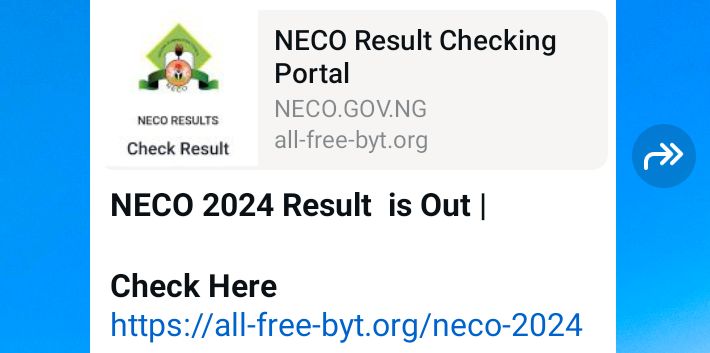
ROUNDCHECK Findings
The National Examinations Council (NECO) is an examination body in Nigeria that is responsible for administering the Senior Secondary Certificate Examination (SSCE) and the General Certificate of Education (GCE). These exams are conducted annually in two sessions: June/July and November/December.
Using ‘e.Veritas,’ a web link verification tool, we discovered that the website attached to the widely circulated post phishing posed a threat to students’ personal and sensitive information.
Phishing is a kind of online scam where cybercriminals attempt to trick individuals into providing sensitive information, like usernames, passwords, credit card details, or personal identification numbers.

Furthermore, we subjected the link to another website verification tool, EASYDMARC, which revealed that the link has a high-security risk level, indicating critical vulnerabilities in Sun Protection Factors(SPF), DomainKeys Identified Mail (DKIM), and Domain-based Message Authentication, Reporting & Conformance (DMARC).
This means that the website poses a threat to users.

Additionally, when we clicked on the link, it prompted a notification SMS (Dear Candidate, Your NECO Result is out, Kindly press OK to check now), indicating further that it is not the authentic NECO website.
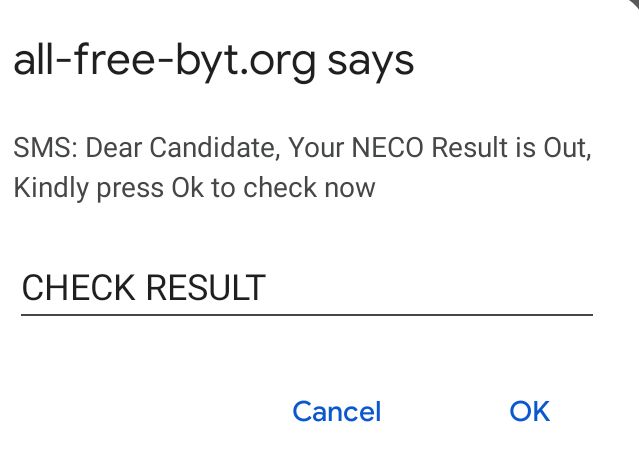
We checked the official NECO website and found that the link provided differs from the one circulating on WhatsApp.
Moreover, there is no mainstream media report indicating that the link or website to access the 2024 NECO result has changed. The correct NECO website is neco.gov.ng while those who want to check their results go through www.results.neco.gov.ng.
Verdict

The link claiming to provide access to the 2024 NECO result is incorrect and poses a phishing threat.
EDITOR’s NOTE: Students are advised to beware of this link and only access their results through the official NECO website as stated in this report.
]]>Claim
A message circulating on WhatsApp claimed that Big Brother Naija is giving out ₦7,000 to Nigerians in celebration of the Season 9 launch.

A part of the message reads:
Big Brother Naija is giving out ₦7,000 to every Nigerian to celebrate the Season 9 launch. Over 600,000 Nigerians have received ₦7,000 each from the BIG BROTHER NAIJA GIVEAWAY.
The sender added a weblink to where people can supposedly claim the money.
ROUNDCHECK Findings
When we clicked on the link to investigate, we received a pop-up message saying ‘Congratulations, you are eligible to receive the ₦7,000 Big Brother Naija Cash Transfer.”
This is without any thorough identification.
A button labelled “Submit Now” accompanied the message.
However, we discovered that the text was editable, meaning users could alter the content and still proceed to the next stage.
That means if you write “Don’t submit” or leave the page blank you will still be allowed to proceed to the next stage.
This raised immediate red flags about the legitimacy of the website.
Moreover, the website had a poor design and structure, closely resembling previous scam websites ROUNDCHECK has debunked in the past.
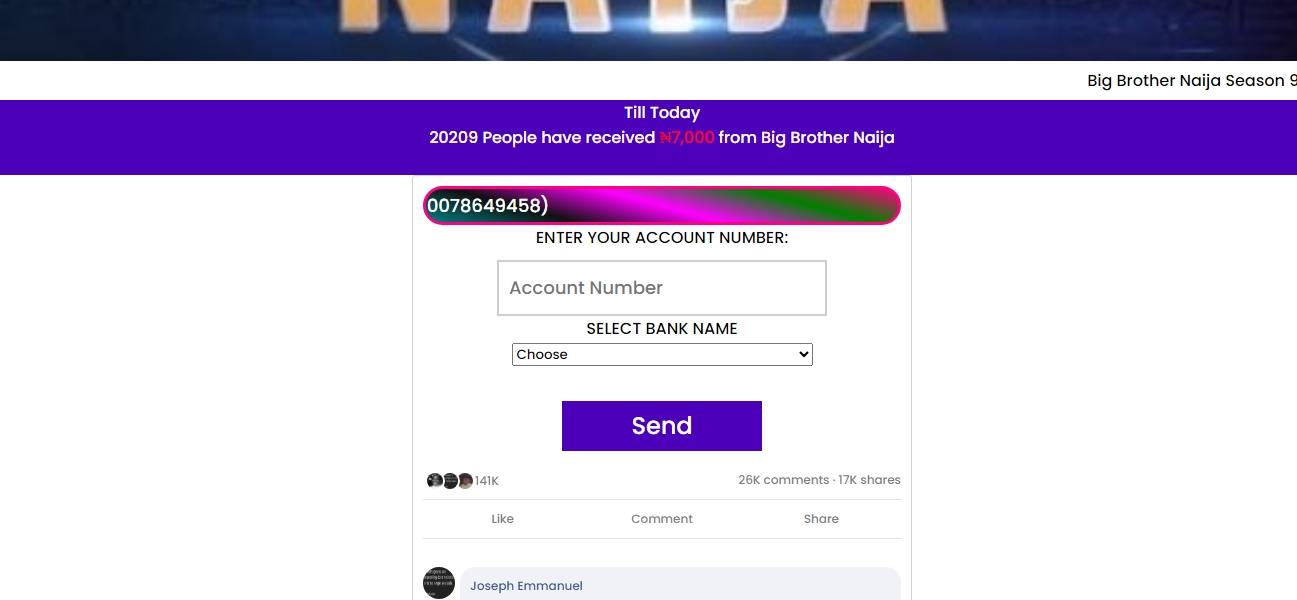
In the next step, we were prompted to enter personal information, such as bank account number and bank name.
After entering random details, a message popped up:
Congratulations, your account number is eligible to receive ₦7,000 from Big Brother Naija. Proceed to get your ₦7,000 cash.
However, to proceed, users were required to share the message with five WhatsApp groups or 15 friends.
Once the “verification” bar is filled up, users are redirected to a different URL https://macilku.blogspot.com which results in an error page.
This indicates the entire process is an attempt to collect personal data fraudulently without delivering the promised payout.
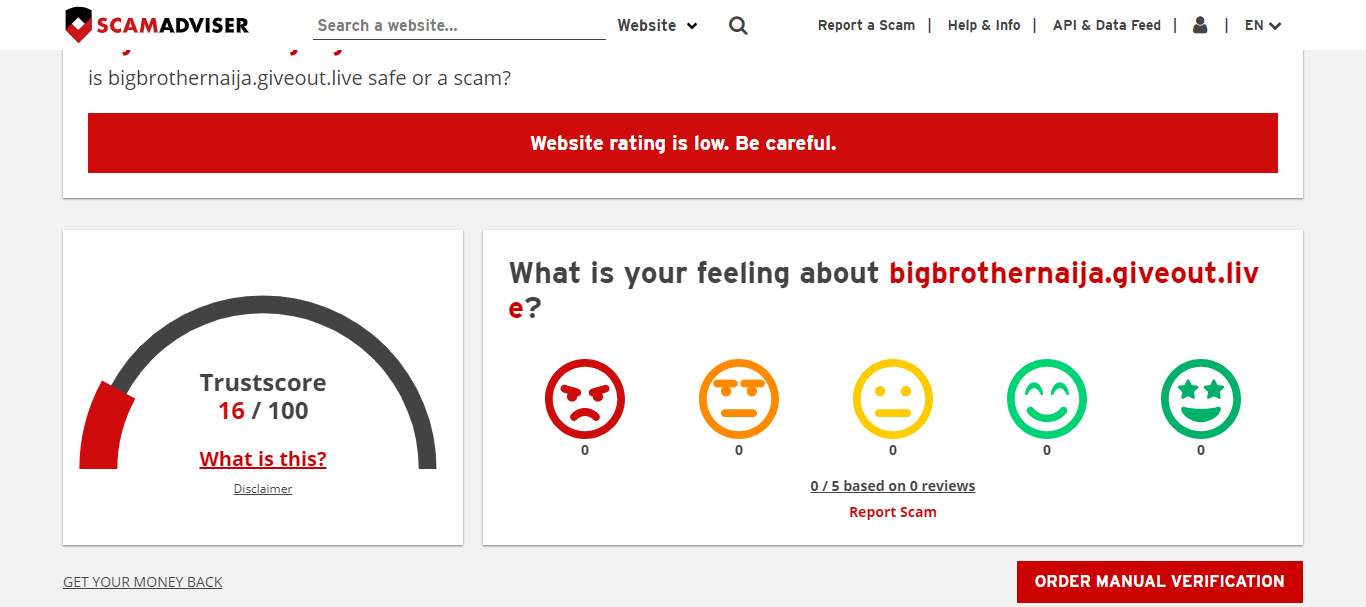
To check further, ROUNDCHECK also subjected the website link to ScamAdviser, an online tool that evaluates websites based on factors such as the identity of the owner, contact information, hosting location, and website technology.
The website so-called Big Brother Naija website https://Bigbrothernaija.giveout.live received a very low trust score and was flagged as potentially unsafe.
Red Flag
Online giveaway scams such as this are becoming increasingly common, with fraudsters using familiar brands and popular events like Big Brother Naija to lure unsuspecting individuals.
These scams usually follow a similar pattern.
They often promise free money or rewards in exchange for personal information or actions, such as sharing messages with friends.
These scams often end in users being redirected to error pages or phishing sites designed to steal information.
These scams not only waste the time of hopeful individuals but can also result in financial losses and identity theft.
Personal information added to these fraudulent websites can be used by scammers to commit more serious crimes, including accessing bank accounts, stealing funds, or compromising the user’s identity for other malicious purposes.
It is important to always verify if the message is coming from an official channel.
Spotting Right Information
For example, official giveaways from a brand like Big Brother Naija will be announced on their verified social media accounts or websites.
ROUNDCHECK reviewed the official social media accounts of Big Brother Naija 2024 but couldn’t find anything related to the post or announcement of a ₦7,000 cash giveaway by the organizers.
Both the Instagram, Facebook, and Twitter pages of Big Brother Naija are not updated with any giveaway, showing that the N7,000 giveaway claim is false.
Verdict
The WhatsApp message claiming that Big Brother Naija is giving out ₦7,000 to celebrate the Season 9 launch is INCORRECT.
It is a fraudulent scheme designed to deceive and exploit hopeful Nigerians.
]]>
By Gloria Ogine
Claim
Viral messages (with links) circulating on WhatsApp claim that Kwara State Governor AbdulRahma AbdulRazaq and his Oyo state counterpart, Seyi Makinde, have approved N10,000 as support palliative for students and civil servants in both states.
The messages, which were composed similarly, claimed it was the governors’ efforts to cushion the effect of subsidy removal.

ROUNDCHECK received these claims on Monday, August 14, 2023, on WhatsApp. The claim has since been going viral on different Whatsapp groups.
How true are the two claims with links? We checked.
ROUNCHECK Findings
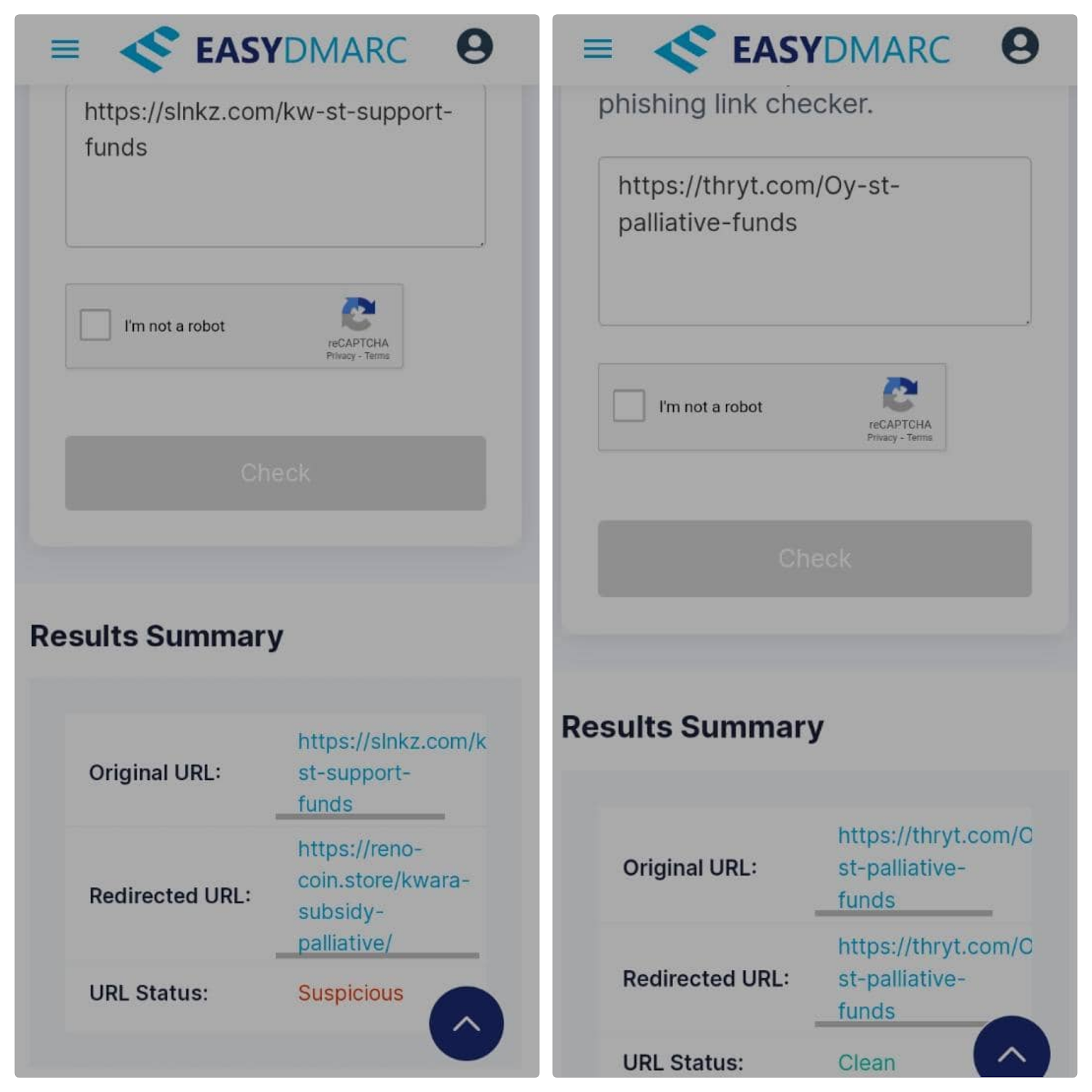
ROUNDCHECK subjected the links (https://slnkz.com/kw-st-support-funds, https://thryt.com/Oy-st-palliative-funds) to a verification process using e.Veritas (a web link verification tool).
We clicked the first link about the Kwara State Governor and the website that opened displayed some glaring grammatical errors: “Kwar State Govt. as approve N10,000 to student, and civil servant” (sic).
The grammatical errors are a red flag, which cannot emanate from government-affiliated officials.

We further used EASYDMARC (another link verification tool) to check the links. We found that the link with the claim about the Kwara State palliative reads suspicious while the one of the Oyo State palliative reads clean (but that does not make the link correct).

We checked the official webpage of Kwara State and found a different link that students have been urged to use for the application for the palliative.
ROUNDCHECK observed that the link circulating on WhatsApp has a different URL from the authentic one that is provided on the Kwara State Government’s official website.
Also, no link was found on the Oyo State Government’s official website and no mainstream media has reported that a portal has been opened for the application of the Oyo State palliative nor did the government announce such.
Our findings showed that the links circulating on WhatsApp about the N10,000 subsidy palliative are suspicious and misleading.
The Oyo State Government did not release any link with which students should apply for the palliative and a statement credited to the Chief of Staff to the Governor of the state, Mr. Segun Ogunwuyi, debunked the claim describing it as fake news.
Verdict
The links claiming Kwara and Oyo State have rolled out N10,000 subsidy palliative are malicious and therefore we rate the claim INCORRECT.
This report was done by the author under the ROUNDCHECK Volunteers’ Network Project cohort III.
]]>Claim
A circulating post on Whatsapp groups has claimed that MTN and Airtel are giving their customers free 10GB of data and N5,000 airtime to celebrate the Nigerian Chef, Hilda Baci’s Guinness World Record for longest cooking time.
The post which was received on May 17, 2023) with a registered link (https://bit.ly/10GB-MTN-AIRTEL-FREE-DATA) attached stated that customers should “hurry now and grab this offer”


“MTN AND AIRTEL CELEBRATE NIGERIAN CHEF, HILDA BACI, FOR BREAKING GUINNESS WORLD RECORD FOR LONGEST COOKING TIME
MTN AND AIRTEL are giving their customers 10gb free data and ₦5,000 Airtime in Celebration of HILDA BACI THE NIGERIAN CHEF FOR BREAKING GUINNESS WORLD RECORD FOR LONGEST COOKING TIME
Hurry now and grab this HILDA BACI CELEBRATION offer
FOR MTN
https://bit.ly/10GB-MTN-AIRTEL-FREE-DATA
FOR AIRTEL
https://bit.ly/10GB-MTN-AIRTEL-FREE-DATA”
However, the website claimed to have a total number of 48,000 comments, 44,000 shares and 196,000 likes as of the time of filing this report.

We checked other social media platforms to detect how viral and widely shared the link had gone. On Twitter, some users had posted the same Hilda Baci free data and airtime link here and here.
On Facebook, we found the same claim by some users here with 25 likes, 2 comments and here.
ROUNDCHECK further went to verify the authenticity of the claim.
Who Is Hilda Baci?
Hilda Effiong Bassey, popularly known as Hilda Baci, recently broke the record of the Indian Chef, Lata Tondon who set a Guinness World Record of 87 hours and 45 minutes for the longest cook-a-thon feat in 2019. Hilda Baci reportedly reached 100 hours and 40 minutes of cooking.
ROUNDCHECK findings
Having obtained the claim, ROUNDCHECK visited the website and followed all the step-by-step processes involved. The first step on the page required the applicant to click on a blue icon to “Get data”.

The first red flag was that the application link had a URL with (“https://bit.ly/10GB-MTN-AIRTEL-FREE-DATA“). That cannot be a traceable website.
On the next page, one could not skip the first instruction to input the mobile number but one could skip the second option to select one network by just clicking on the green send icon.
The last page which congratulates applicants on their eligibility, asks them to click on the share button and share the link on 5 groups or with 15 friends on WhatsApp before proceeding to activate their reward.

We discovered that if applicants refuse to share it in groups or with friends but keep navigating back, the progress bar increases itself to 100%.
At the end after clicking the activate button, we were directed to a lucky draw to win 10 million naira on a website page.
All these actions make the website suspicious. We did more research by scanning the website using Scamadviser and found it to be more suspicious.

Although the trust score of the website is 100%, the identity of the website is hidden on Whois, it changes to ‘bit.com’.

We also discovered that several spammers and scammers use the same registrar as the website. Meanwhile, we noticed that the web keeps changing links with one click. It changed from a lucky draw page to a Bet9ja page that asked people to open an account.


Checking MTN and Airtel Websites, Social Media
ROUNDCHECK carried out thorough findings on MTN and Airtel’s official websites. We did not find such free offers coming from these telecommunication companies.
We further visited the official webpages of MTN and Airtel, unfortunately, there was no information assuring customers free data or airtime to celebrate Hilda Baci’s Guinness World Record. MTN‘s social media accounts have no such claim.
The only post on Airtel’s Facebook page was made on May 15th, 2023, cheering Hilda Baci to set her record but no free data or airtime offer was attached.
Verdict
The circulating post which claimed that MTN and Airtel are giving out free 10GB of data and 5,000 airtime to celebrate Hilda Baci’s cook-a-thon Guinness World Record is INCORRECT. It is a hoax created to scam unsuspecting members of the public.
This fact-check report was done by one of the volunteers under the 3rd cohort of the ROUNDCHECK Volunteer Network.
]]>
Claim
A Short Message Service (SMS) claims the president-elect, Bola Ahmed Tinubu, of the All Progressives Congress is giving volunteers who worked for his victory the sum of N 86,890.
A ROUNDCHECK researcher received the message at exactly 7.05 am on April 5th, 2023.

The text message has a phone number attached to it which a volunteer is expected to reach out to claim the compensation.
The SMS reads: “APC THANK YOU FOR ALL YOUR HARD WORK AS A VOLUNTEER FOR TINUBU YOU HAVE BEEN GIFTED 86,890 FOR THE BETTERMENT OF NIGERIA CALL David 09067137945 FOR PAYMENT”.
Another version of the claim received by a source on 6th April, 2023 reads: APC approves 2023 presidential election 85,000 HAS BEEN APPROVED BY TINUBU TO RECEIVE MONEY CALL Mr DAVID 07038271456 FOR PAYMENT
We noticed a difference in the amount promised by the viral text messages.
While the first SMS promised potential beneficiaries the sum of N86,890, the second SMS received promised the sum of N85,000.

ROUNDCHECK also observed that the text messages are error-filled and have no regard for the president-elect as the former governor is being regarded simply as “Tinubu”.
Also, the messages are woefully lacking in punctuation as well as in grammar, a red flag that the SMSs did not emanate from an official source.
Brief About Bola Tinubu
A former Lagos State governor and senator, Bola Ahmed Tinubu emerged as Nigeria’s president-elect in the concluded 2023 elections.
On March 1st, the Independent National Electoral Commission, INEC declared Tinubu with his running mate, Ibrahim Kashim Shettima the winner of the election held on February 25th.
The president-elect secured a total of 8,794,726 votes, the highest of all the candidates and he will be sworn-in as President on May 29, 2023.
Volunteer Groups For Tinubu
In the build-up to the elections, many volunteer groups nationwide declared support for Tinubu’s presidency.
For instance, in Kano State, 10,000 persons reported volunteered to be Tinubu’s agents in Kano.
Also, volunteer groups, who promised to mobilise people who will vote for Tinubu, were inaugurated in Lagos, Edo, Oyo States, and across many other states.
ROUNDCHECK Findings
ROUNDCHECK decided to put a call through to a phone number attached to the text message to verify if truly the sender of the SMS is from Tinubu’s camp.
This was a few hours after receiving the message.
We dialed the phone number using TrueCaller, a smartphone application that has features of caller-identification among other advantages.
The display name was: ‘John Bayo Scammer’.

The calls were not answered twice. But the ‘scammer’ called back.
The logic behind not picking up the calls, as ROUNDCHECK later found out, was to prevent any form of interruption during the telephone conversation which might occur due to exhaustion of airtime.
Verification From APC Team
ROUNDCHECK reached out to Bayo Onanuga, the Director Media and Publicity, Tinubu/Shettima Campaign, to confirm the trending text message promising monetary gift.
No response to email and Twitter direct messages sent to Onanuga and APC national youth leader, Dayo Israel on 9th and 12th April respectively (up until now, no reply despite reminders)

Efforts to contact the chairman of APC in Ogun state, Yemi Sanusi also proved abortive as he did not respond to several calls on the 11th and 12th of April.
Meanwhile, ROUNDCHECK reached out to an APC youth leader and member of various volunteer groups for the party in Ogun state, Habeeb Whyte, who confirmed that the claim of APC giving incentives after elections is untrue.
“This is an attempt by some elements to destroy the democratic values and image of our great party, APC.”
“There is nothing like post-election gifts at all,” he said.
Whyte further added that: “Most volunteers that worked for the emergence of Asiwaju Bola Ahmed Tinubu from the primaries to the main election did it out of love and belief that they have in Asiwaju’s candidacy. They never did it for cash or gifts. It is an insult to any volunteer that has been alleged to collect gifts as post-election proceeds.”
Being a legal practitioner, Whyte mentioned that “.. it would not be in a bad place for those scamming people with post-election gifts to be arrested and prosecuted.”
Meanwhile, we spoke to Lulu Fawehinmi, a member of the Progressive Young Leaders Summit Steering Committee under the office of APC Youth Leader. He said the claim is a scam.
“There is nothing like that,” he maintained.
WORD FOR WORD: The Telephone Conversation With The Scammer
The conversation started at exactly 9:42 am on April 5th, and it lasted for 7 minutes, and 6 seconds:
Scammer: Hello. Good afternoon, I saw your missed call.
ROUNDCHECK: Good morning, sir
ROUNDCHECK: I received a message, and I tried to reach out to the attached contact.
Scammer: What is your name, and where are you calling from?
ROUNDCHECK: Sulaiman Tunji from Ibadan, Oyo State (wrong name).
Scammer: Which bank are you using and would like to receive the money?
ROUNDCHECK: I’m using Opay.
Scammer: Opay?
ROUNDCHECK: Yes.
Scammer: We don’t have a network in Opay, sir. The banks we have network with is Union bank, FCMB, Keystone, or Union. Do you have any of them? [sic]
ROUNDCHECK: No.
Scammer: What’s the account number of the Opay, sir?
ROUNDCHECK: 2133…
Scammer: The account number of Opay?!
ROUNDCHECK: Please, sorry. Let me cross check the account number. I just opened it recently, and I don’t know it offhand. Are you still there?
Scammer: I’m with you.
Scammer: Hello. Hello.
ROUNDCHECK: I’m with you, sir.
Scammer: I want to go to the car… (Talking in the background) Hello… (Noise of car honking was loud in the background)
ROUNDCHECK: Yes, I’m with you.
Scammer: Leave that place, it’s noisy; I can’t hear you.
ROUNDCHECK: Can you hear me now? 7011… (wrong number)
Scammer: This is not the Opay account number. It’s not correct. (He called the numbers out again.)
ROUNDCHECK: Yes.
Scammer: It’s not correct na.
ROUNDCHECK: Let me check and call you back.
Scammer: Can’t you call the account number of the First bank?
ROUNDCHECK: I don’t know the number offhand.
Scammer: Be on the call and check the account number of the Opay na. Be on the call and check the account number of the Opay.
ROUNDCHECK: Ok. (Received an OTP from Opay despite not having an Opay account).

Scammer: Hello, sir.
ROUNDCHECK: Hello, I’m still looking for it. Hold on.
Scammer: Do you have an ATM card?
ROUNDCHECK: No, I use mobile banking. Please, while I’m looking for the account number, I would like to know the branch of the APC party giving this gift so that I will express my gratitude during one of their meetings.
Scammer: I am not calling from the bank (mistaking BRANCH for BANK).
ROUNDCHECK: Yes, that’s why I would like to know whom to thank during the party’s meeting.
Scammer: (Stammering)…
ROUNDCHECK: Another concern of mine is that TrueCaller flagged your number as ‘John Bayo Scammer’. Why?
Scammer: (Stammering…) are you telling me that I’m a scammer or what? Which kind of nonsense is that?
ROUNDCHECK: No, I’m just asking out of curiosity, sir.
Scammer: It’s your problem… no, phone that’s doing like that.
ROUNDCHECK: But TrueCaller is more like an application that…
Scammer: Hold on! Shut up! If you’re not interested in the gift, you can hang up the call.
ROUNDCHECK: Hello. Hello…
Scammer: (He stammers)… then hangs up the call.
We also contacted the phone number in the second SMS. TrueCaller displayed the number as ‘David Pdp’. By ‘PDP’, it means the People’s Democratic Party (an opposition political party in Nigeria).
However, all efforts to reach the number on 10th April proved abortive as the calls were not answered.

Word For Word Conversation With Second Scammer
But the next day, April 6th, ROUNDCHECK reached the number again and the receiver, also a male, immediately yelled out:
David Pdp: Are you an APC member?!
ROUNDCHECK: I received a…
David Pdp: (He cuts in) call your account number to receive the money. If you want to call it, call it.
The conversation that follows was different from the previous one as the ‘David Pdp’ was impatient and was yelling having discovered that the Opay account number called out was incorrect.
One would wonder why a PDP number is the sender of an APC cash gift. This is a red flag because both political parties are two strong oppositions in Nigeria.
NOTE: More Findings
ROUNDCHECK is aware how scammers are acquainted with digital banks.
Thus, we traced the two numbers to Opay (a digital bank operating in Nigeria where phone numbers are also used as the account number) by attempting to transfer money across to the owners of the number.
We were able to spot the real name attached to the Opay account number (07038271456) as Oluwatoyin Samuel Adesegun.
Although, more searches to link to the social media accounts were not positive as there were many accounts with that name. Chances proved that it is either the scammer used his full real name and phone number or he used a third-party information (because his display name on TrueCaller and bank name are contradicting).

We also inputed the mobile number of the second scammer (09067137945) on mobile banking apps to trace him. The number used by the scammers second shows no relevant information from the display name. A red flag that he is hiding his identity.

ROUNDCHECK findings show that the phone number attached to the text message has been flagged as SCAMMER and the telephone conversation with the sender confirms it.
Also, we discovered that the person who answered the call put through to the second phone number followed a similar format as the first scammer did– they were both impatient, aggressive and quick to demand for the account number without proper introduction.
Meanwhile, bank management already warned customers not to reveal their transaction pin to anyone, neither will a staff of the bank call to request for One-Time Pin (OTP).
Verdict
We, therefore, confirm that the claimants are scammers trying to dupe unsuspecting members of the public by accessing their bank accounts to presumably hack and transfer their funds.
The scammers are hiding under the guise of providing gift incentives on behalf of the President-elect of Nigeria, Bola Ahmed Tinubu., for winning the 2023 Presidential election.
Our findings showed that neither the President-elect, his party, nor his campaign team is involved in sending messages to Nigerians to claim any cash gift as a post-election incentive.
EDITOR’S NOTE: ROUNDCHECK has observed these patterns by scammers to gain access into bank accounts of unsuspecting members of the public. We admonish our readers and members of the public not to give their personal bank information to an unauthorized person(s)
]]>