This claim, seen on X, has gathered 74 reposts, 54 comments, 435 likes, and 64,000 bookmarks (which is a way to privately save posts for later access), as of May 15, 2025.
Also, another X account with 1million followers posted the same claim, stating that Ibrahim Traoré wants to create the United States of Africa, where all African countries will come together as one. According to the post, there will be one government system, one currency, “Afro Money”, and one African passport.

This claim was also seen on Facebook, with some Facebook users resonating with it.
A user, Claudia Chuo commented that: “To me United States of Africa will not be differentiated from the United States of America. I wish we call it United Nations of Africa. U N A.”
Another user, Ehichioya Asine stated that “This is the true light of Africa and may this wind of change blow through all nations of Africa continually in the name of the lord Jesus. Amen”
Ibrahim Traoré is a Burkinabé military officer and politician who has served as the interim President of Burkina Faso since 2022.
Traoré took control of Burkina Faso in September 2022, ousting interim president Paul-Henri Sandaogo Damiba in a coup d’état.
Ibrahim Traoré has increasingly been admired by Africans and social media users, largely due to waves of viral social media content, some of which has been discovered to be false and AI-generated.
This wave of digital support, however, masks a more complex and concerning reality. While Traoré is celebrated online as a pan-African hero, his regime has been criticised for its authoritarian tendencies and human rights abuses
These contents, often inaccurate or misleading, portray him as a brave reformer who has stood up to Western influence and restored dignity to the Burkina Faso nation. These claims have spread widely on social media such as TikTok, Facebook, and X (formerly Twitter), presenting Traoré as a commendable leader.
Seeing the growing pan-African sentiments, ROUNDCHECK decided to investigate this claim because it could mislead the public on a highly sensitive geopolitical issue and fuel disinformation around pan-African unity.

ROUNDCHECK Findings
ROUNDCHECK searched through various verified media platforms and noticed there have been no statements from Ibrahim Traoré supporting the broad goal of creating a United States of Africa.
However, his government has expressed support for a potential federation with Mali and Guinea. In September 2023, these three countries formed the Alliance of Sahel States, a grouping primarily focused on addressing security concerns in the region.
While this alliance could be seen as a step towards greater regional integration, it doesn’t explicitly align with the concept of a continent-wide United States of Africa.
ROUNDCHECK discovered that the “Afro Money” mentioned in the claim didn’t come from President Ibrahim Traoré but rather came from a Senegalese artist, Mansour Ciss.
“Afro Money” is an artistic currency project by Mansour Ciss for 14 African nations that used to be French colonies.
Furthermore, the removal of restrictions on the free movement of Africans across the continent has been a key goal of the African Union (AU), which launched the African passport project in 2016.
Although a continent-wide African passport for all citizens doesn’t exist yet, the African Union (AU) has introduced a new passport for its officials and diplomats, but the goal is to eventually make this passport available to all African citizens, enabling visa-free travel across the continent. This, however, is not being pushed by Ibrahim Traoré.
ROUNDCHECK checked the Burkina Faso government website, and nothing related to this claim was found. This also applies to the official government social media handles. (X and Facebook)
Verdict
The claim that President Ibrahim Traore planned to unite African countries into the United States of Africa is FALSE. ROUNDCHECK findings revealed that there is no evidence of such a claim at the time of this report.
This report was done under the Roundcheck Volunteer Network Cohort 4
]]>The claim was mostly circulated between May 21 to May 24, 2025.
The claims surfacing on several social media platforms, including X and TikTok, have several videos and images depicting violence in the country’s capital, Abidjan, and a possible military takeover in Ivory Coast.
Some of the comments under the X post expressed desires for this coup. @gerald_okocha commented that “It is not yet confirmed. I pray it’s true oooooo”. On TikTok, others who believed the claim prayed for a coup in other African countries, including Kenya and Nigeria.
@marwanabdulaziz62 commented “We pray for Nigeria to join insha Allah”
This is coming in the build-up to the general elections slated to hold on October 25 in Ivory Coast.
Ivory Coast has been marked with several political conflicts, from a 1999 military coup to civil war in 2011, to the recent court ruling barring opposition candidate Tidjane Thiam from contesting the forthcoming elections because of his current French nationality.
Concerns have been raised over the possible reelection of the current president for a fourth term after a constitutional amendment in 2016 that allowed him to run for a third five-year term in 2020.
This led to a protest resulting in the death of at least four people.
Although social media users have been seen to glorify military takeovers in West Africa recently, these posts depicting a military takeover in Ivory Coast are capable of stirring political violence in the forthcoming election, hence the need for ROUNDCHECK to investigate it.
ROUNDCHECK Findings
On May 21, 2025, an X user posted that there was an ongoing coup d’état in Ivory Coast, adding that Africa would be liberated through the barrel of a gun. Another X user shared this video depicting a coup in Ivory Coast, and as of Tuesday, 27th May 2025, it had garnered 500 retweets and 1000 likes.

ROUNDCHECK’s findings revealed that the video is misleading. A reverse image search of the video keyframe revealed that the video was from a violent fire that broke out on February 5, 2025, in the annex building of the Château Shopping Centre, located in the Adjamé district of Abidjan, the Ivory Coast capital.

Another X user posted a video claiming Ivory Coast military Coup was successful, and the president has allegedly fled the country. This claim video has been viewed 149,500 times and has been retweeted 2,500 times as of Tuesday, 27th May, 2025.

ROUNDCHECK, however, discovered that this video posted was from Burkina Faso, and not Ivory Coast as claimed
TikTok Is a Haven For This Misinformation
Some of the videos ROUNDCHECK saw on X originated from TikTok influencers. For example, this misleading video that appeared on X was initially shared by an Ibrahim Traoré supporter, Arouna Burkinbila (sawadogo1066), who has a large followership on TikTok.

Arouna has most of his content glorifying the Burkina Faso junta leader.

ROUNDCHECK noticed that the video which Arouna shared was edited to fit his narrative of a coup in Ivory Coast. The original video was obtained from another TikToker. This video, which is not related to Ivory Coast or Africa, was edited by Arouna.

Narrative Is Being Pushed On X
ROUNDCHECK observed that several X users posted this claim of a coup in Ivory Coast, with some more popular and having a large following, which gave the claim traction.
ROUNDCHECK identified some of these accounts.

Our investigation revealed that the claims that a Coup took place in Ivory Coast, and the images and videos attached, are all false, manipulated or unrelated.
A deeper finding also revealed that the handlers of these X accounts mostly post content around coups, military takeovers or foreign dominance in Africa. The simple aim is for engagements, click baits and propaganda.
Military Coup In Ivory Coast Is False
The information about the military takeover of Ivory Coast flooded several social media platforms on Wednesday, 21st of May, 2025. ROUNDCHECK findings revealed that these claims are false, as there was no coup in Ivory Coast.
The President, Alassane Ouattara, on the same day when the coup information was shared, presided over a council of ministers meeting at the presidential palace in Abidjan, the Ivorian capital.
According to the official X account of the presidency, discussions around affordable housing and solar power plants were raised during the meeting.
This debunked the claim that the Ivory Coast President had fled the country because of the coup.
On the 22nd of May 2025, President Ouattara offered a speech during the ceremony of the Award of the Félix HOUPHOUËT-BOIGNY – UNESCO Peace Prize in Abidjan.
Also, the African Development Bank (AfDB) Group’s 2025 Annual Meetings kicked off on Monday, 27th May, with Ivory Coast being the host country, and President Ouattara was present.
ROUNDCHECK checked reputable news platforms like CNN, BBC and Ivory Coast media platforms, Abidjan, and Fratmat, and there was no report of a coup in the country. Al Jazeera, however, debunked these social media claims.
Call For Military Takeover In West Africa
Since the coup that rocked several countries in the Sahel region, the call for military takeover in other parts of West Africa has been cutting through borders. Several actors who use disinformation techniques have had to glorify these junta leaders, causing further distrust in the democratic system.
DUBAWA has initially reported how thousands of users are spreading pro-authoritarian narratives using disinformation techniques and inciting young Ghanaians and Nigerians to take up arms and push back democracy.
This is the same for an X User, @MartynsObot, who commented on one of the misleading videos cited by ROUNDCHECK, expressing displeasure over the continued democratic rule in Nigeria.
“If there are still brave military men in Nigeria like we had before OBJ retired some most of them, by now d streets of Nigeria would be buzzling with echo of joy like this. But unfortunately, what we have now in camouflage are vegetables who care only for what gets into pockets,” [sic], the X user said.
As these trends continue to become more visible, the Africa Center for Strategic Studies warns that these disinformation campaigns have directly driven deadly violence, promoted and validated military coups, cowed civil society members into silence, and served as smokescreens for corruption and exploitation.
The Center revealed that Disinformation campaigns seeking to manipulate African information systems have surged nearly fourfold since 2022, triggering destabilising and antidemocratic consequences.
“West Africa is the region most targeted by disinformation—accounting for nearly 40 percent of documented disinformation campaigns in Africa. Roughly half of these attacks are connected to Russia,” part of the report reads.
Disinformation Threatens Democracy In West Africa
Disinformation poses a serious threat to democracy and undermines trust in public institutions, warns Malik Samuel, a Senior Researcher at Good Governance Africa.
He cited the recent circulation of false reports about a coup in Ivory Coast as a stark reminder of how disinformation can destabilise democratic governance in the region.
“Even when unfounded, such claims can cause significant harm by weakening public trust in state institutions, normalising unconstitutional actions, and fuelling political and ethnic tensions,” Malik explained.
He added that disinformation can disrupt electoral processes, destabilise regions, and spread fear and uncertainty among the public.
According to Malik, the growing calls for military coups in parts of Africa stem largely from deep-rooted public frustration over poor governance, insecurity, economic hardship, and the erosion of democratic values.
He noted that many people, especially the youth, feel politically and economically marginalised.
“This sense of exclusion is made worse by attempts from some political leaders to prolong their rule through constitutional manipulation, which further undermines the legitimacy of democratic institutions,” he said. “As a result, coup narratives are increasingly resonating with young people who, seeing their future prospects diminish, feel stifled by authoritarian governments that suppress dissent.”
Malik emphasised that these conditions create fertile ground for bad actors to exploit public discontent, often through the rapid spread of disinformation online. The rise of digital platforms and social media has made it easier than ever for individuals to spread false narratives without verifying their accuracy.
To address this threat, Malik called for a multifaceted response, including robust public education through mass media, consistent fact-checking, and a firm commitment to transparent and accountable governance, where citizens feel genuinely included, heard, and confident that their votes matter.
Ikemesit Effiong, Partner and Head of Research at SBM Intelligence, added that strengthening democracy also requires deeper citizen engagement and forward-thinking discussions around civic inclusion.
He noted that many people in West Africa feel that democracy has not delivered tangible benefits in their daily lives or led to real development in their communities.
“For many in the region, the question is: what’s the point of democracy? If it doesn’t result in better schools, higher-paying jobs, improved living standards, or a brighter future, why are we pursuing it?” he asked.
Effiong argued that for democracy to regain its legitimacy in the region, governments must deliver better outcomes for their citizens. Failing to do so could render their continued hold on power questionable.
He also called for more media literacy programs to educate citizens about the core tenets of democracy and equip them to recognise disinformation. He urged experts to adopt the same tactics used by disinformation purveyors to reach wider audiences, especially those in power.
“We need more explainer videos. We need more experts to become independent content creators,” he said. “Part of the legitimacy crisis stems from the perception that almost all institutions—including legacy media—have lost public trust. That’s why we need independent voices who understand information integrity to take to platforms like TikTok and YouTube.”
Effiong concluded by emphasising the need for more public educators and greater investment in programs that empower academics, researchers, and institutional actors to build independent platforms that deepen media literacy and democratic awareness.
]]>
On the 7th of October, the Palestinian militant group, Hamas launched an attack from the Gaza strip on Israel on 7 October, killing 1,400 people and taking more than 200 hostages. Heavily armed men breached the fences separating Israel and Gaza and entered southern Israel. According to Israeli officials, at least 1,400 people were killed, many of them civilians, including children.
Following this attack, Israel Officially Declared War on Hamas. Prime Minister Benjamin Netanyahu said Israel “is at war” after Hamas launched a devastating surprise attack on the country on Saturday, 7th October.
“Citizens of Israel, we are at war. Not an operation, not a round [of fighting,] at war! This morning Hamas initiated a murderous surprise attack against the state of Israel and its citizens,” Netanyahu said in a statement.
The war has persisted for more than 10 days while recording more than 2000 deaths, thousands injured and more than 1 million have had to flee their homes.
What Is Hamas and Gaza Strip?
The Gaza Strip, which some have called “the world’s largest open-air prison,” is a narrow piece of land between Israel and Egypt.
More than 2 million Palestinians live in the 140-square-mile enclave, making it one of earth’s most densely populated places. Hamas is currently controlling it.
Hamas, also spelled Ḥamās, the acronym for Harakat al-Muqawama al-Islamiya (Islamic Resistance Movement), is described as a militant Palestinian nationalist and Islamist movement in the West Bank and Gaza Strip that is dedicated to the establishment of an independent Islamic state in historical Palestine.
It was founded in 1987, and was labeled a foreign terrorist organization in 1997, by the United States, freezing its U.S.-based assets, barring members from entering the country, and banning the provision of “material support or resources”.
HAMAS has been the de-facto governing body in the Gaza Strip since 2007 when it ousted the Palestinian Authority from power.
Misleading Contents Found In The Israel-Hamas War
ROUNDCHECK has noticed several misleading contents spreading across social media platforms about the Israel-Hamas war. We have carefully analysed the claims and have done due diligence to reveal the authenticity of some of the information we obtained.
Claim 1
A video clip claimed that Harvard University students demonstrated against Israel’s crimes against the Palestinians.
The video posted on October 19th, was shared multiple times with that caption across X and Facebook, generating thousands of views and reactions.
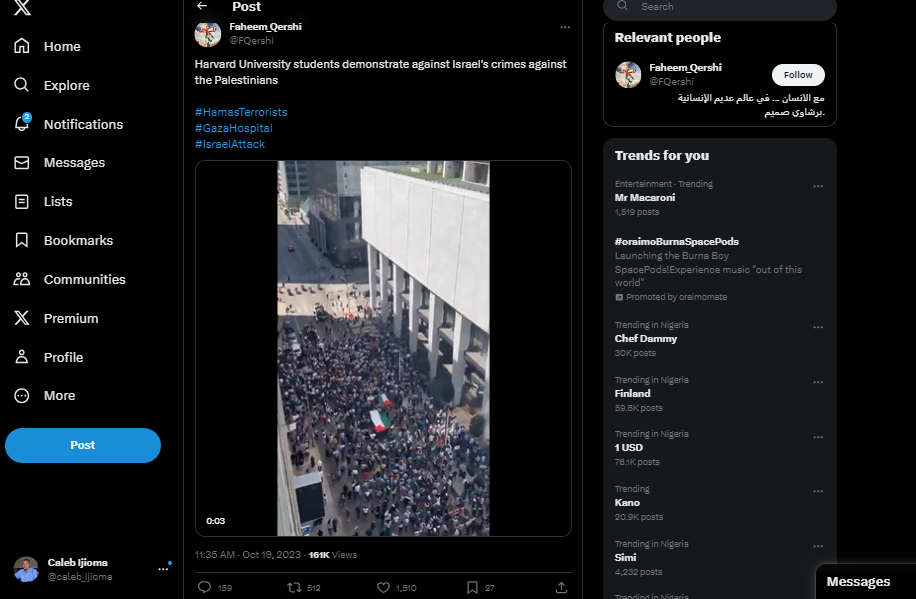
We also saw this video and same caption was shared multiple times on X
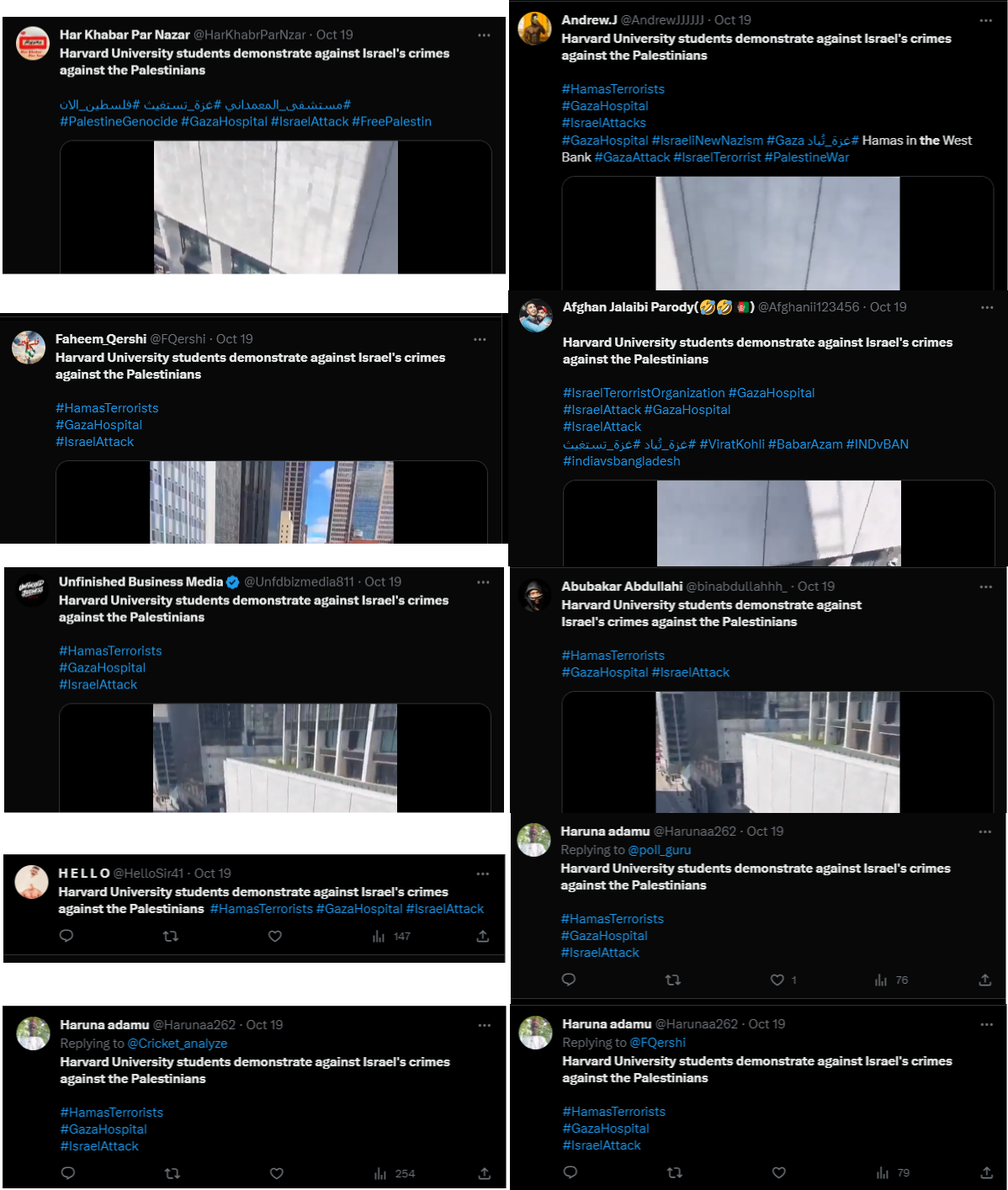
ROUNDCHECK Findings
We subjected the video to INVid, a video verification tool that provided us with several keyframes.
We later conducted a Google reverse image search, which revealed the said video was a protest in downtown Dallas Texas.
A News & media website, Mega News, uploaded the video on their Instagram account on October 16th with the caption “Huge protest in downtown Dallas Texas in solidarity with Palestine and the oppressed people of Gaza!!”
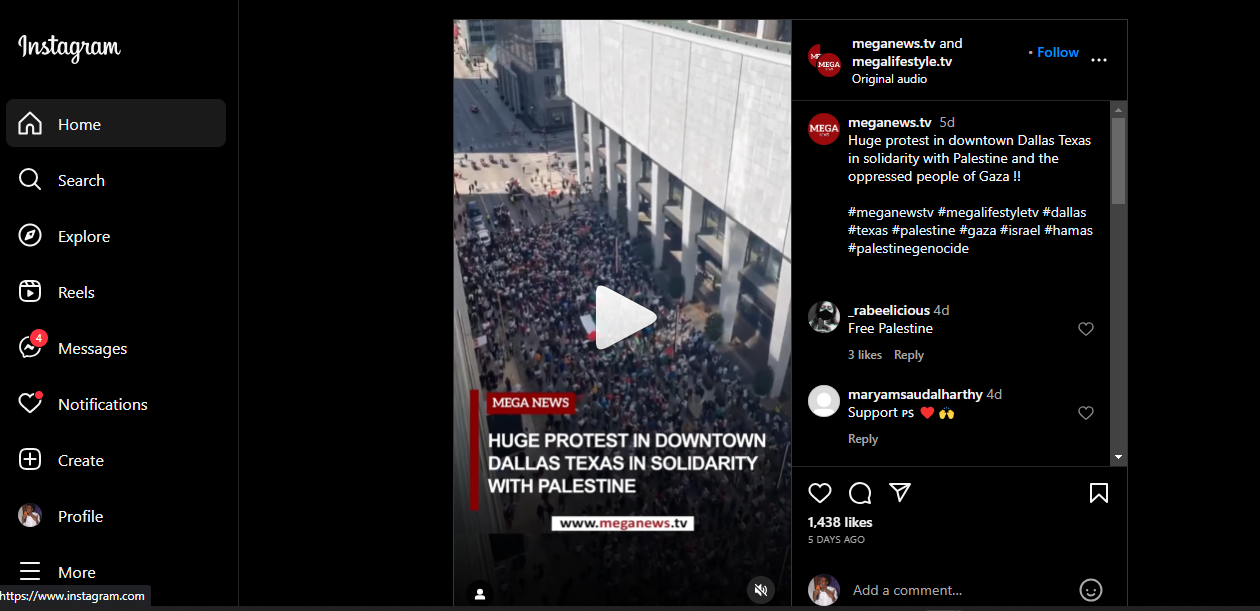
We further confirmed the location of the protest through Google Maps.
However, our findings further revealed that although there was a protest by Harvard University students, it wasn’t until the 18th of October, two days after the video surfaced.
Harvard students held a protest in support of Palestine and marched from Harvard’s main campus in Cambridge to its business school in Boston.
The video was used in another event, not the Harvard University student protests.
Verdict

This video clip claiming that Harvard University students demonstrated against Israel’s crimes against the Palestinians is misleading.
Claim 2
A San Francisco former TV anchor at KTVU, Frank Somerville, on his verified Facebook page on the 20th of October, shared his opinion about the Isreal-Hamas war.
Somerville referenced Israel’s defense minister, Yoav Gallant visit to some of the hundreds of thousands of troops who have massed on the border with Gaza.
This post also accompanied four images depicting the level of damage the current war has had on the people of Palestine.
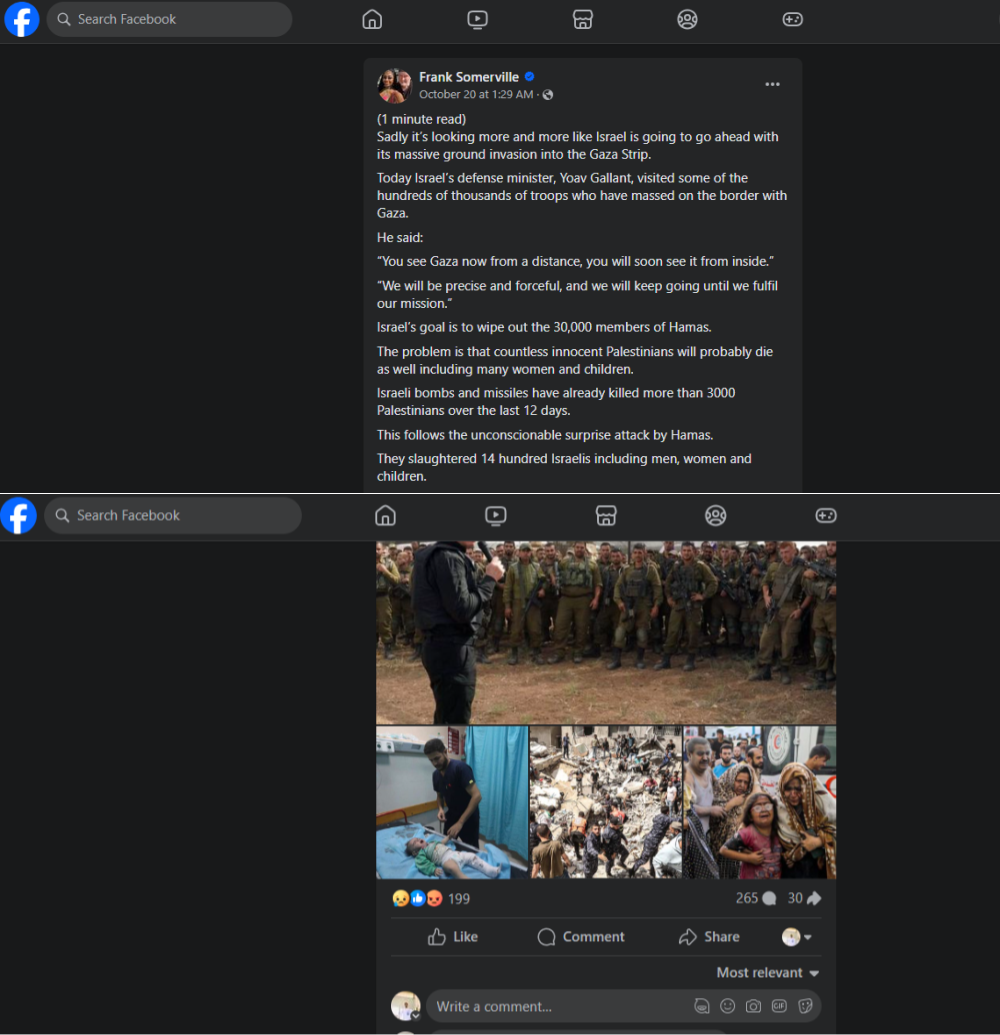
This post garnered 199 reactions, 265 comments, and 30 shares as at the time of this report.
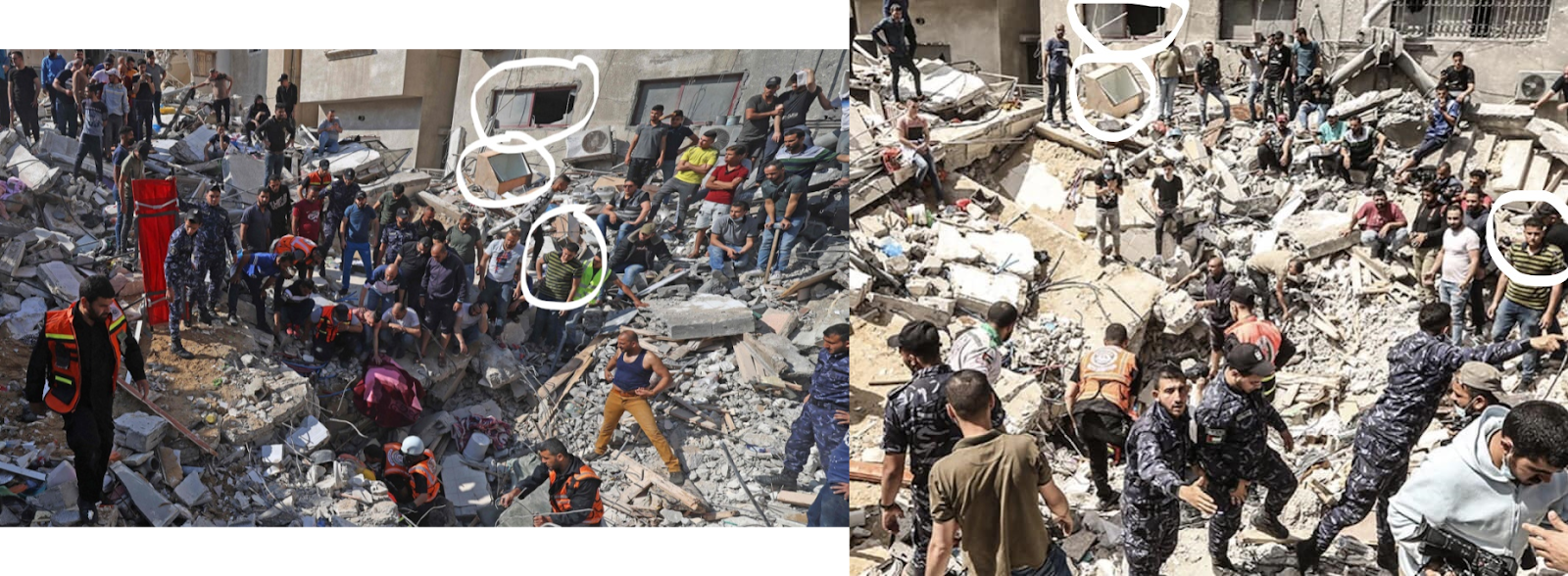
We checked through the images and noticed one of them was an old picture.
ROUNDCHECK Findings
ROUNDCHECK in a bid to verify the images, subjected them to several image verification tools and noticed one of the images was an old picture used in May 2021.
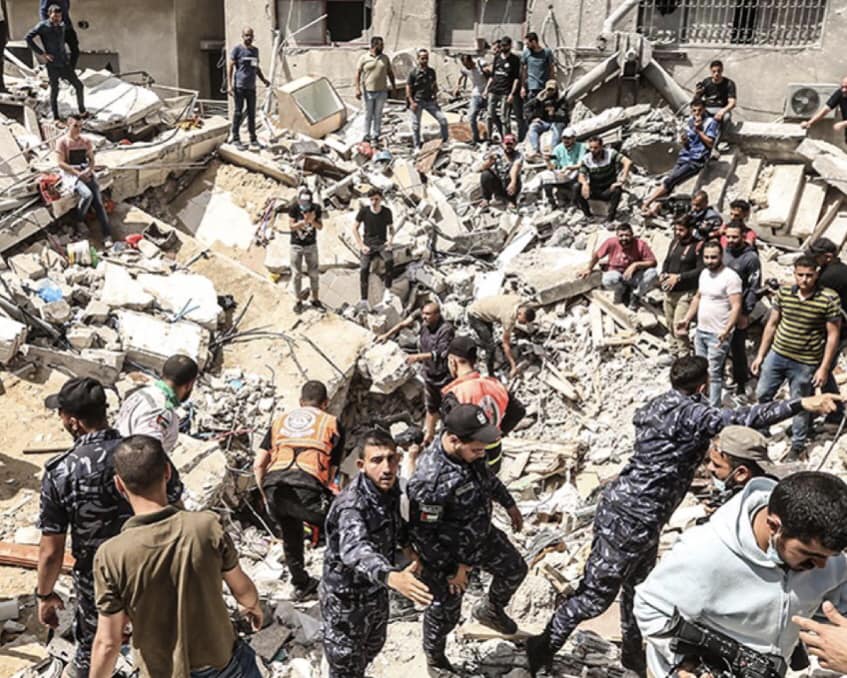
Our findings revealed that this picture was also recently used in a post on WBAI – 99.5 FM In New York City website, and also a Hong Kong news website, BNN News.
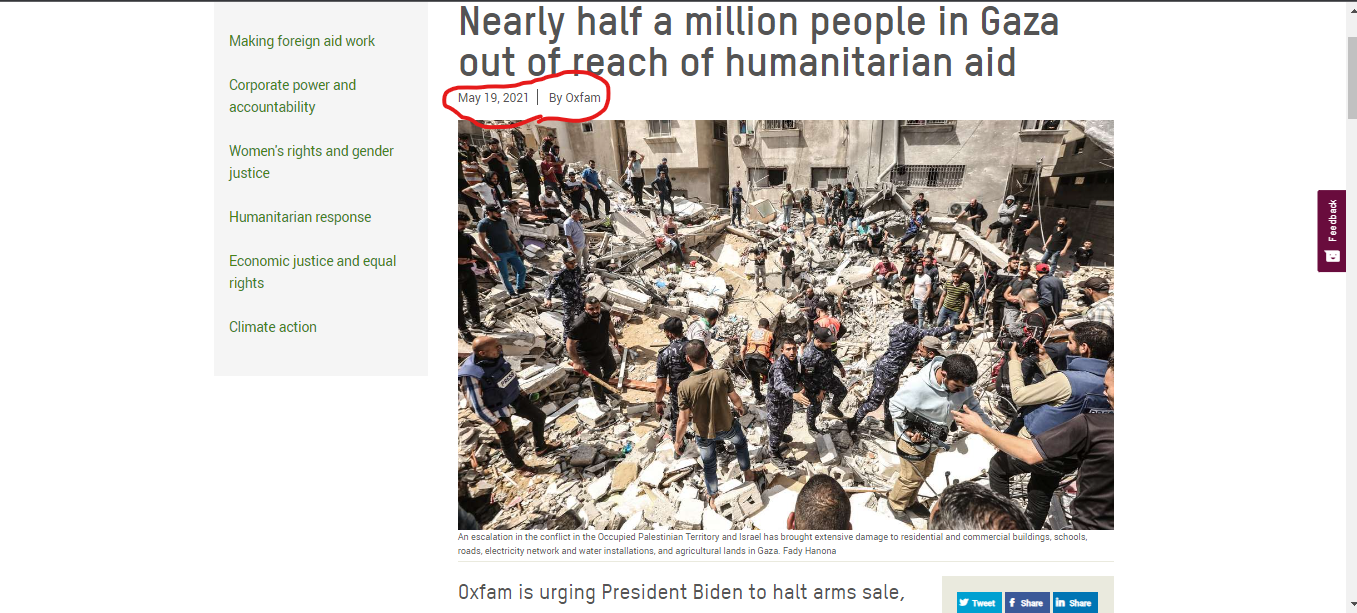
We, however, traced the image to a post made by Oxfam America on their website published on May 19, 2021, with the title “Nearly half a million people in Gaza out of reach of humanitarian aid”.
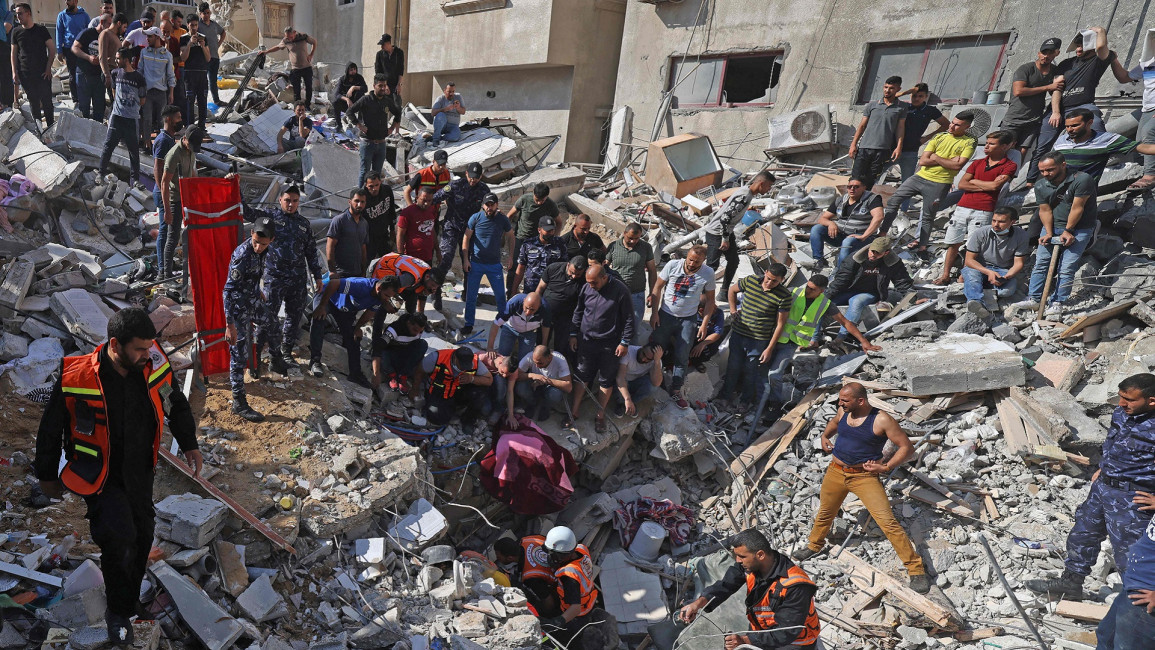
We went further to check and saw a news report published on 16th May 2021 of a bombardment of the home of the Hamas political chief in Gaza. The image used in the news report was a similar image.
Verdict
One of the images used in the Facebook post of Somerville to depict the level of damage the current war has had on the people of Palestine is MISLEADING.
Editor’s Note: The war between Isreal-Hamas-Palestine continues but there are a range of misleading images used to depict the war and it is necessary to debunk them.
]]>Mr Udom made these claims while comparing the living situations between these two West-African Countries.
He said, “Comparing Apples to Apples:
Minimum wage:
Ghana N25,300
Nigeria – N30,000
Fuel Price/ltr
Ghana – N350
Nigeria – N165 (officially)
House Rent:
Ghana + 8% Tax Nigeria + 0% Tax
There is no free lunch anywhere in the world! If Nigerians want a developed economy we simply have to PAY for itit!”
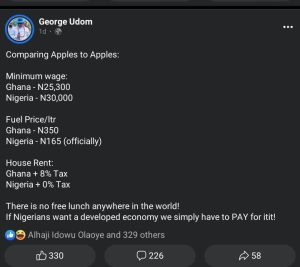
This post has generated a total of 330 likes, 226 comments, and 58 shares at the time of fact-checking.
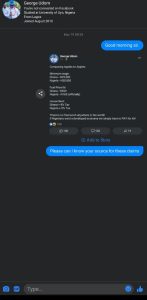
When contacted for the source of his claims, Mr Udom left the inquiry message unanswered on his Facebook chatbox.
Roundcheck’s Findings
Claim 1
That minimum wage in Ghana is N25,300, while N30,000 in Nigeria
Findings by Roundcheck show that the claim that N30,000 is the monthly minimum wage in Nigeria is accurate, but that N25,300 is the monthly minimum wage in Ghana is false.
According to information available, as of March 2022, on Wageindicator, a non-profit organisation that shares and compares information about wages, labour law and careers in 196 countries globally, the minimum wage in Ghana is GHS13.53 daily, which is equal to 776.19 in Nigerian currency, according to Currency Matrix’s convert.
In Ghana, monthly minimum wage figures are calculated as daily minimum wage × 27 days, according to Wageindicatior. So going by mathematical calculation, GHS 13.53 in 27 days is equal to GHS 365.31 —equivalent to 20,820.64 in Nigerian currency.
Meanwhile, in Nigeria, the monthly minimum wage is N30,000 (522.94 in Ghanian cedis). According to Wageindicator, The minimum wage in Nigeria is based on monthly income with an average working period of 8 hours daily and 5 days weekly.
Verdict: While N30,000 as the monthly minimum wage in Nigeria as claimed by Udom is TRUE, the minimum wage in Ghana is GHS 13.53 (N776.19) daily, GHS 365.31 (N20,820.64) monthly, not N25,300 as claimed by Udom. This claim is Partially True.
 Claim 2
That 1 litre of fuel costs N350 in Ghana, while the official price is N165 in Nigeria.
According to a record found at GlobalPetrolPrices.com, petrol price in Ghana, according to data updated as of 14, March 2022, is GHS 8.618 per litre, equivalent to 491.18 in Nigerian currency.
The above price was also confirmed by Statista. According to them, as of March 14, 2022, the price of gasoline in Ghana stood at 8.62 Ghanaian cedis (GHS) per litre, corresponding to roughly 1.21 U.S. dollars.
Further findings reveal that the above update is the most recent, as at the time of writing this report, on petrol price in Ghana.
Meanwhile, in Nigeria, presently, the official pump price of petrol (PMS) is N165 (2.87 in Ghanian cedis, equivalent to 0.39 US Dollar), NigerianPrice.com — an online resource designed to help Nigerians (and others) to keep abreast of current prices of products and services available in the country, revealed.
The Verdict: The official petrol price in Nigeria is N165 as claimed, hence TRUE. But findings by this reporter revealed that the fuel price in Ghana is N491.18, not N350 as claimed, hence FALSE. This claim is Partially True.
Claim 3
That house rent tax in Ghana is 8%, while it is 0% in Nigeria.
According to Ghana Revenue Authority, There are two rates for rent tax; 8% for residential premises and 15% for non-residential premises.
Meanwhile, in Nigeria, despite several controversies that trail the issue of house rent tax, finding show that rent derived from the lease of real properties, whether for residential or commercial purposes, is not a supply of goods or services and is therefore not liable to Value Added Tax(VAT). What this means is that house rent tax in Nigeria is not recognised by the law.
The Verdict: The claim is TRUE.