The event, organised in partnership with RoundCheck, brought together leading voices in media, technology, and democracy to explore how AI is shaping public trust and what must be done to safeguard the 2027 polls.
Anchored by Chiamaka Okafor, Executive Director of the MILID Foundation, the panel featured Prof. Suraj Olunifesi, Associate Professor of Mass Communication at the University of Lagos and Global Co-Lead of the UNESCO University Network on MILID; Caleb Ijioma, Executive Director of RoundCheck; Hannah Ajakaiye, Founder of FactsMatterNG; and Lois Ugbede, Assistant Editor at Dubawa Nigeria.
The discussion was moderated by Opeyemi Toriola, a Media and Information Literacy (MIL) educator.
In the open session, Prof. Olunifesi laid out the stakes clearly. He explained how AI could compromise electoral integrity, from deepfakes to algorithm-driven misinformation, and warned that similar tactics have already undermined democracies elsewhere.
“When citizens begin to think their votes no longer count,” he said, “trust in the system collapses.” That kind of doubt, he added, could create space for foreign interference or even nudge a democracy toward authoritarianism.
For him, the antidote is awareness.
“We need to know who is regulating AI, who is inventing it, and what data is being used to train it,” he said. “Regulation won’t work without education; we must first educate to regulate.”
He also urged for greater transparency and stronger collaboration among government, civil society, and the tech industry to ensure that AI strengthens democracy rather than erodes it.
Moderator Tangi Toriola praised the timing of the discussion, noting that having such conversations more than a year before the elections, rather than just a few months ahead, gives citizens and policymakers time to act.
Lois Ugbede described the theme as “a call to build public resilience in the age of AI-powered misinformation.” While AI brings efficiency and creativity, she said, it also opens new fronts for falsehoods. Her message was simple: every citizen must become their own fact-checker.
Caleb Ijioma echoed that sentiment, calling AI “a double-edged tool.”
“Young people must realise that AI can influence who they vote for and how they vote,” he said. “But it can also be used for good.”
He revealed that Roundcheck is developing a civic education web game to help users spot misinformation and engage responsibly online. “With strong media literacy skills, people can tell what’s true or false and help others do the same, he added.
For Hannah Ajakaiye, the evolution of misinformation has been alarmingly fast.
“In 2019, it was cheapfakes. In 2023, it was deepfakes. By 2027, we might be facing hyperrealistic AI videos that even fact-checkers struggle to verify,” she warned.
She also highlighted the “liar’s dividend”, a growing trend where politicians dismiss genuine evidence as AI-generated fabrications. “A politician can now deny an authentic video, claiming it’s AI,” she said.
As a solution, Ajakaiye said, “Media and information literacy has to reach every community, in every language, and that’s how we build resilience against misinformation”.
Throughout the session, one point kept resurfacing: education must come before regulation. Prof. Olunifesi noted that even regulators often lack the technical understanding needed to govern AI effectively.
Each panellist shared how their organisations are tackling that gap:
Dubawa, represented by Ugbede, continues to expand its Kwame Karikari Fellowship for journalists across West Africa and runs media literacy programs in schools nationwide.
FactsMatterNG, led by Ajakaiye, produces short, relatable videos in Pidgin English to reach everyday people who do not usually consume traditional media.
Roundcheck, through training sessions and volunteer programs, equips young Nigerians with fact-checking and digital literacy skills.
As the discussion wrapped up, panellists outlined practical steps to prepare for 2027. Their recommendations included:
- Social media platforms and users tagging AI-generated content for transparency
- Developing a deepfake policy tailored for Africa
- Promoting homegrown tech tools for misinformation detection
- Expanding grassroots media literacy training before the elections
- Teaching AI literacy to INEC officials and civic groups
Prof. Olunifesi also cautioned against overreliance on AI, warning that without proper education, the technology could displace jobs and destabilise systems designed to serve democracy.
Closing the session, Chiamaka Okafor thanked the speakers and participants, reaffirming MILID Foundation’s commitment to advancing media literacy and strengthening Nigeria’s democratic resilience ahead of 2027.
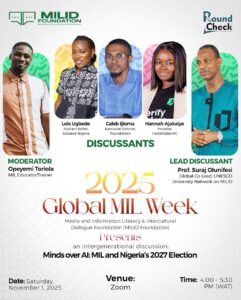
]]>The virtual event themed “Minds Over AI: MIL and Nigeria’s 2027 Election,” is organised in partnership with ROUNDCHECK, and will bring together journalists, fact-checkers, and media literacy experts to examine how AI could influence political communication, information credibility, and voter behaviour ahead of the polls.
Organisers say the discussion is timely as Nigeria moves closer to another election year. The 2023 general elections highlighted how technology can drive political narratives, with deepfakes and coordinated disinformation campaigns used to sway public opinion.
As AI tools become more common and accessible, experts are increasingly concerned about their potential to distort facts and undermine public trust in democratic processes.
However, the Foundation also believes AI offers fresh opportunities to strengthen democracy, especially when used responsibly to improve information accuracy and civic participation.
The panel will feature Prof. Suraj Olunifesi, Associate Professor of Mass Communication at the University of Lagos and Global Co-Lead of the UNESCO University Network on MILID, as the lead discussant. He will be joined by Hannah Ajakaiye, Founder of FactsMatterNG; Caleb Ijioma, Executive Director of ROUNDCHECK; and Lois Ugbede, Assistant Editor at Dubawa Nigeria.
The session will be moderated by Opeyemi Toriola, a media literacy educator and trainer.
In a statement, Chiamaka Okafor, Executive Director of MILID Foundation, described the conversation as both urgent and necessary.
“One thing we are assured of in 2027 is that we will have a population heavily impacted by artificial intelligence. Now we must worry about what this impact will translate into in terms of the credibility of the elections,” she said.
She added that the session will equip journalists and citizens with the tools to critically engage with AI-driven information environments.
The virtual event will be held via Zoom from 4:00 p.m. to 5:30 p.m. (WAT). Interested participants can register through:
https://us06web.zoom.us/meeting/register/4umIuqRhR7e6XySPdpmyqQ
]]>