The viral post circulating on WhatsApp claims that a child identified as ‘Gift’ is suffering from a serious medical condition and needs 1,983,000 naira for surgery. The post appeals for public donations and provides a bank account belonging to one Abdulsalam Momodu (Kuda Bank) while urging users to pray, share, and support the child financially.
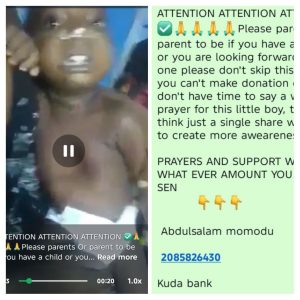
At first, I felt sympathy and considered contributing. But the repetition caught my attention. WhatsApp had also indicated that the message had been forwarded many times.
Why was the same video circulating through multiple accounts with identical messages? That simple moment of curiosity became the beginning of a deeper search for the truth.
ROUNDCHECK Findings
ROUNDCHECK observed that the post provides a personal bank account belonging to one Abdulsalam Momodu (Kuda Bank), with the account number 2085826430, for receiving donations. When entered into a bank transfer app, the name of the bank details matched.
After, we conducted a Google reverse image search and discovered that the image attached to the donation appeal appears to be a screenshot taken from a YouTube video (Archived here).
The image shows a young child wearing a diaper, which the viral appeal presents as evidence of the child’s alleged health condition. Examination of the image revealed visible clues from what appears to be a YouTube interface, including details that could be used to trace the original content.
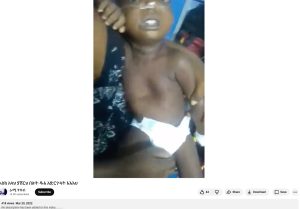
Using these clues, ROUNDCHECK conducted keyword searches and cross-checked the search results with the information visible in the screenshot. The search led to a matching YouTube video, which was then reviewed and compared with the image attached to the viral appeal to establish whether the content had been previously published and to determine its original context.
The video was posted on March 20, 2022, on @Ramii22’s YouTube channel (Archived here) and has 44 likes and 427 views. In the description of the video, an Amharic text was written and translated to English as ‘Until Allah heals him, say a prayer (dua) for him.’
Also, on June 3, 2026, the video was posted on Taiwo Adako’s YouTube channel (Archived here).
However, the image and video alone do not establish a) the identity of the child b)the location of the child c) the person who uploaded the video d) whether the child in the image is connected to the donation request or whether the requested funds are genuinely for medical treatment.
However, at the time of this investigation, there was no publicly available evidence confirming that Abdulsalam Momodu is the child’s parent or guardian, that the account is linked to a recognised hospital, that the child’s condition has been medically diagnosed, or that a verified medical facility issued the requested surgery amount.
Further checks led us to an Instagram post made by amycharleshopefoundation (Archived here) on Instagram on July 17, 2025, using the same video.
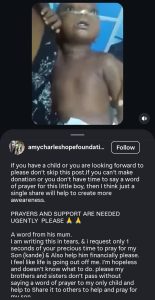
In the description of the post, the name of the child was mentioned as Kande. ROUNDCHECK noticed that the amount requested from the public is different from the previous claim ( ₦1,960,000 and said he only has ₦250,000). This differs from the first claimed amount and account information.
The account information on the post is for one Auwal Aisha, with account number 7025694542 attached to MOMO PSB Bank. ROUNDCHECK confirmed that the account details are active for transferring money.
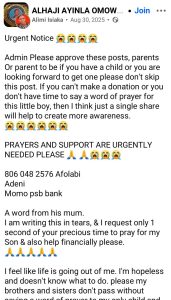
This video was seen on Instagram (Archived here). Also, it was posted on Facebook by Alimi Isiaka in a group named Alaaji Ayinla Omowura, Fans Club, The Eegunmogaji of Egbaland Worldwide. The details for payment also changed to Afolabi Adeni, 8060482576, MoMo PSB Bank.
Analysis of Possible Red Flags
The viral appeal contains several features that are commonly associated with online donation campaigns that require careful verification before members of the public decide to contribute. One of the most noticeable characteristics is its use of highly emotional language.
Phrases such as “I am writing this in tears” and “my son is dying slowly as days pass by” are designed to evoke sympathy and create a sense of urgency, encouraging readers to respond emotionally rather than critically assessing the authenticity of the claim.
Another notable feature is the repeated call for immediate action. The post urges readers to donate whatever amount they can afford and to share the message widely.
While genuine fundraising campaigns often encourage public support, the emphasis on urgent donations without first providing verifiable evidence may pressure people into making quick decisions without conducting basic checks.
The appeal also lacks essential medical documentation that would normally accompany a legitimate request for financial assistance.
It does not include the name of the hospital treating the child, a medical report, a doctor’s diagnosis, a treatment invoice, or any official documents confirming the child’s condition and the cost of the proposed surgery.
The absence of such information makes it difficult for potential donors to independently verify the appeal’s authenticity.
Furthermore, the donations are requested through a personal bank account rather than a hospital account, a registered charity, or another recognised fundraising platform.
Although using a personal account does not necessarily indicate fraudulent intent, it reduces transparency. It makes it more difficult for donors to confirm that their contributions will be used for the stated medical purpose.
Very specifically is the account number is always changing for everyone who posted the image. The inconsistency is a red flag.
Taken together, these indicators do not conclusively prove that the fundraising appeal is fraudulent. But the red flags should raise the consciousness that something does not add up in the different posts.
Also, they raise legitimate concerns and underscore the importance of verifying online medical donation campaigns before making financial contributions.
Expert Opinion: Why Medical Verification Matters
To understand whether a person’s medical condition can be verified through photographs shared online and the role of medical documentation in fundraising, Dr Bibilari Adewusi, a medical practitioner, spoke to ROUNDCHECK when we shared the image and the call for financial appeal with him.
According to Dr Adewusi, it is not always possible to accurately determine a person’s medical condition from photographs or videos alone, although some illnesses may present obvious physical signs.
He explained that recent controversies surrounding false medical claims on social media have contributed to growing public scepticism.
Dr Adewusi noted that certain diseases can sometimes be recognised visually.
“Depending on the medical condition, there are clinical conditions that one can identify from sight. For example, patients with goitre or cancrum oris (noma) may display obvious physical abnormalities that suggest they are unwell. However, a photograph alone cannot provide a definitive diagnosis or determine the exact nature or severity of a disease.”
On the documentation required for genuine medical fundraising, Dr Adewusi emphasised that medical reports should accompany public appeals for financial assistance.
“Ideally, medical reports should accompany such appeals. Unfortunately, recent incidents have shown that even medical reports can be manipulated. This means the public must now verify not only that a report exists but also that it is authentic,” he concluded.
To further examine how Nigerians can verify online medical fundraising appeals, ROUNDCHECK spoke with Nurse Taiwo Okediran, who works at the University College Hospital Ibadan. She cautioned that photographs and videos circulating online cannot, on their own, establish a child’s diagnosis, the severity of the condition, or the need for surgery.
She explained that while visible signs such as severe thinness, breathing difficulties, abdominal swelling, jaundice, seizures or visible masses may indicate that a child needs medical attention, proper diagnosis requires medical history, physical examination and, where necessary, laboratory tests or imaging.
Okediran said genuine medical fundraising appeals should provide current medical reports, official hospital cost estimates, relevant diagnostic records and consistent patient information. However, she cautioned that medical documents can also be manipulated, making independent verification important.
She advised donors to verify the child’s identity, diagnosis, hospital, treatment cost, and beneficiary’s bank account before donating. She also recommended using official hospital contacts to confirm claims and, where possible, paying directly into the hospital’s account.
“Urgency should never bypass fundamental verification. Taking time to verify the child, diagnosis, hospital, cost, and account ensures that assistance reaches legitimate patients while protecting donors from fraudulent appeals,” She said.
Verdict
The viral donation appeal is misleading because it recycles an older video with altered names, donation amounts, and bank details, without verifiable evidence linking the child to the fundraising claim.
]]>