A viral WhatsApp message claimed that the Central Bank of Nigeria (CBN) has introduced 5,000 naira and 10,000 naira notes, set to circulate on May 1, 2025.
The message also states that a Deputy Governor of CBN, Dr Ibrahim Tahir Jr. made the announcement.

CBN’s Currency Redesign Policy In 2023
In early 2023, the Central Bank of Nigeria (CBN) announced a currency redesign to combat counterfeiting and money laundering.
The redesign led to widespread hardship, with long queues and confusion. The Supreme Court ruled on November 29, 2023, that both old and new notes should remain legal tender. In December 2024, the CBN confirmed there would be no deadline for old note circulation.
ROUNDCHECK Findings
From our findings, the CBN has not made any announcement regarding the introduction of ₦5,000 and ₦10,000 notes. A review of the official CBN website (http://cbn.gov.ng) shows no such policy or press release.
However, the circulating message was spotted to be signed by one “Dr. Ibrahim Tahir Jr., Deputy Governor of CBN.”
Findings reveal there are four CBN Deputy Governors, and we looked through each of them.
After our findings, we could not find any individual who holds the position of CBN Deputy Governor with the name ‘Dr Ibrahim Tahir Jr.
The current Deputy Governor of CBN (Economic Policy) is Muhammad Sani Abdullahi, while the other three do not bear Ibrahim Tahir (see image below).

We analysed other viral ‘forwarded messages’ on WhatsApp, where images of the claimed naira notes were attached. There were inconsistencies in the look and design of the notes and does not reflect Nigerian currency.
We discovered that all existing naira denominations in Nigeria have the name ‘Central Bank of Nigeria’ at the top of both sides.
But in contrast, the claimed new 5,000 and 10,000 naira notes don’t have that name.
The claimed notes have no name of the Central Bank’s governor- as it is in other denominations. Nothing indicated that the notes were from Nigeria’s Central Bank.
Also, on April 2, 2025, the CBN debunked that the images of designed 5,000 naira and 10,000 naira notes are fake.

While there have been past discussions on introducing higher denominations, particularly during the 2023 currency redesign policy, no such move has been implemented by the CBN.
Hence, the information in the viral WhatsApp message is misleading, and the website link provided is incorrect.
The Supreme Court ruling on November 29, 2023, allowed both old and redesigned naira notes to coexist, but no new denominations were introduced.
Verdict
The claim that CBN has introduced 5,000 naira and 10,000 naira notes, is INCORRECT.
]]>On 15th November, a popular celebrity and activist on X known as @AreaFada1, noted in a tweet that Mali is now a debt-free country.
In his exact words, he said: “Mali is now a debt free country. The country’s Finance Minister has announced, Mali becomes the first African country to be debt free. After the military took over, they sold all the assets belonging to the corrupt elites and sent them to jail including the former president’s son & Ministers. When will it be our turn?”.
The tweet which gained 5200 likes, 1700 retweets and 273k views went viral in the Nigerian social media space and attracted 413 comments (still counting).
Also, on LinkedIn, Emerging Alkebulan (Alkebulan Innovative Foundation), with 4,548 followers, made a similar post and gave details about the claim, emphasising that ‘Mali, under the leadership of General Assimi Goita, has achieved a significant milestone by becoming the first African nation to be debt-free.’
He noted that Mali’s achievement in becoming debt-free is commendable and serves as a beacon of hope for other African nations.
The post has since then gained 76 comments and 46 reposts at the time of compiling this.
Where is Mali?
Mali known officially as the Republic of Mali is a landlocked country situated in West Africa. It is the eighth-largest country in Africa with an area of over 1,240,192 square kilometres (478,841 sq mi).
The country shares a border with Algeria to the North then Niger to the East, with Mauritania to the North West.
Mali also shares a border with both Burkina Faso and Ivory Coast to the South and Guinea with Senegal to the West.
The country’s Capital, Bamako is the largest city in the country. With a population of 24,478,595, Mali is governed by a military junta headed by Assimi Goita who is the interim President after a successful coup he led in April 2021.
ROUNDCHECK Findings
The junta-led West African nation’s economy has been rocked by two coups in 2020-2021 and consequent regional sanctions which have contributed significantly to the continued high debt profile of the country.
On the 20th of October, Mali Economy and Finance Minister, Alousseni Sanou, in a news report by Reuters, acknowledged the increasing challenges the country is facing as debt repayment efforts begin.
The report disclosed that Mali will pay off 200 billion CFA francs ($332 million) of its internal debt starting from the following week until the end of the year in a bid to ease its debt burden.
In the report, IMF analysis warned that the direction and pace of debt accumulation are worrisome and that Mali’s domestic debt had risen from a low base of 8.1% of gross domestic product in 2015 to 22.1% as of 2021.
In another report, Mali’s economy minister revealed that the country expected to pay off $1.015 billion in domestic debt as part of its 2024 budget plan to ease the debt burden
However, the repayment of the $322 million of internal debt does not make the country debt-free as there are still other pending debts and financial obligations the country needs to fulfil.
According to official data, Mali’s domestic debt stood at CFA2,965.9 billion(about $5 billion) in 2023, making up over 55% of the country’s total public debt.
On the 18th of October, Moussa Diallo, Mali’s Minister of Industry and Commerce, during a session broadcasted by ORTM (Office de Radiodiffusion-Télévision du Mali), emphasised the broader impact of reducing the debt.
According to him, “By paying CFA 200 billion of the domestic debt, we are looking to restore the cash flow of businesses, help them meet their obligations to banks, and support domestic consumption. Overall, this initiative should help kick-start the economy.”
Mali’s Debt Profile
In 2022, Mali’s public debt was 51.7% of its GDP, and its external debt was $3,923,341,002. In the decade leading up to 2022, Mali’s public debt averaged 38.3% of its GDP. The World Bank and IMF projected that the public debt will increase to 47% of GDP in 2023, and then gradually decline to 43.2% of GDP in 2030.
According to Statista, the national debt in Mali was projected to continuously increase between 2024 and 2029 by 4.4 billion U.S. dollars (+36.64 per cent).
According to the International Monetary Fund, the general government gross debt consists of all liabilities that require payment or payments of interest and/or principal by the debtor to the creditor at a date or dates in the future.
The main external creditors were the IMF, World Bank, African Development Fund, West African Development Bank, Islamic Development Bank, and the governments of France, China, India, and Abu Dhabi.
IMF noted that Mali’s outstanding purchases and loans (SDR) were $344.68 million as of September 30, 2024, with Mali’s contingent liabilities estimated to be 14.3% of GDP at the end of 2024.
Mali’s debt service reached a historical record of $292 million in 2021. In 2022, Mali’s budget deficit widened to 5.3% of its GDP.
The International Monetary Fund (IMF) has warned that Mali’s debt accumulation is worrisome. However, Statista forecasts that Mali’s debt-to-GDP ratio will decrease to 54.41% by 2029.
Can a country be debt-free?
ROUNDCHECK findings showed that a country can be debt free but it is difficult to achieve. With the Heavily Indebted Poor Countries (HIPC) Initiative launched in 1996 by the International Monetary Fund (IMF) and World Bank, it can only help countries avoid unmanageable debt.
Also, in 2005, the Multilateral Debt Relief Initiative was added to help countries reach the United Nations’ Sustainable Development Goals. Countries that complete the HIPC Initiative process can receive 100% relief on eligible debts.
Findings revealed that these achievements paved the way for Somalia to conclude the Enhanced Heavily Indebted Poor Countries (HIPC) Initiative in December 2023.
As a result, the country received $4.5 billion in debt relief from the World Bank’s International Development Association (IDA), the International Monetary Fund (IMF), the African Development Fund, other multilateral creditors as well as bilateral and commercial creditors, mostly members of the Paris Club.
This achievement reduced Somalia’s external debt from 64% of GDP in 2018 to less than 6% of GDP by the end of 2023, allowing the country to re-enter the global financial system following two decades of isolation.
Conclusion
Our findings revealed that Mali is not a debt-free country yet.
]]>The full text of the claim reads: “Today, Lagos signed a contract with China Civil Engineering Construction Corporation to build the Lekki-Epe Bridge. This is the same Lagos that just finished the Red Line, already has a Blue Line, and is about to start a Green Line. The same Lagos that they asked you to invest in at your own peril.
Akwa-Ibom has built its state-owned Ibom Deep Sea Port and has one of the most profitable airlines in Africa, Ibom Air, which flies out of its state-owned airport.
Ondo is building its own $1 billion state-owned port and has reduced poverty faster than any state in Nigeria, according to the National Bureau of Statistics.
So, I ask you again, Other than dancing Gwo, Gwo, Gwo, Ngwo, what has your own state Governor achieved?
#TableShaker”

ROUNDCHECK Findings
Claim One:
Reno Omokiri claims “Lagos signed a contract with China Civil Engineering Construction Corporation to build the Lekki-Epe Bridge. This is the same Lagos that just finished the Red Line, already has a Blue Line, and is about to start a Green Line. The same Lagos that they asked you to invest in at your own peril.”
On 4th September 2024 Governor Babajide Sanwo-Olu, Executive Governor of Lagos State signed a Memorandum of Understanding with China Civil Engineering Construction Corporation for the construction of the Lekki-Epe Bridge and the implementation of solar power systems across the tertiary institutions in the State, which includes Lagos State University and its campuses, Lagos State University of Science and Technology, Lagos State University of Education, and Lagos State College of Medicine.
On this same day, a Memorandum of Understanding (MoU) with the Federal Government and China Harbour Engineering Company (CHEC), a Chinese company for the Green Line Rail Project. According to the Lagos state government, “the rail line will link Marina, Victoria Island, and the Lekki Free Trade Zone, and aims to enhance transportation in the Lekki corridor. The project will significantly reduce travel time, ease traffic congestion, and support economic growth within the Lagos metropolis and its surrounding areas.”
Impact of Lagos Red and Blue Rail Lines on Transportation
The Lagos Red and Blue Line rail projects have significantly transformed transportation in the city. The Blue Line, running from Marina to Mile 2, carries thousands of passengers daily, while the recently commissioned Red Line, which spans from Agbado to Oyingbo, is expected to transport 250,000 passengers per day. These lines reduce road congestion, cut travel times, and integrate with other transport systems like Bus Rapid Transit (BRT) and ferry services, enhancing the overall efficiency of Lagos’ transportation network.
Verdict:

The claim about the Lekki-Epe Bridge is CORRECT. As of September 4th, 2024, Governor Babajide Sanwo-Olu signed a Memorandum of Understanding with China Civil Engineering Construction Corporation for the bridge’s construction while the Green Line Rail project contract was awarded to China Harbour Engineering Company (CHEC), confirming Reno Omokri’s statement.
Additionally, the Lagos Red and Blue Line rail projects have significantly improved transportation, reducing congestion, cutting travel times, and integrating with other systems like BRT and ferries.
The Red Line is expected to transport 250,000 passengers daily, further enhancing the city’s transit network.
Claim Two
“Akwa-Ibom has built its state-owned Ibom Deep Sea Port and has one of the most profitable airlines in Africa, Ibom Air, which flies out of its state-owned airport.”
Akwa-Ibom Airline and Ibom Deep Sea Port
The Ibom Deep Seaport, a federal government project driven by the Nigerian Port Authority and Federal Ministry of Transport in collaboration with Akwa-Ibom state, is set to revolutionize Nigeria’s maritime industry. This project received the Federal Executive Council (FEC) approving the Outline Business Case in May 2015 and was designed to accommodate mega vessels capable of carrying over 13,000 containers in a single voyage, the port will serve as a transshipment hub, with smaller vessels redistributing cargo to nearby sea and river ports, both domestically and internationally. Global Maritime & Port Services PTE Limited is leading the project’s transaction, poised to transform the region’s economic landscape.
ROUNDCHECK discovered the project to be under construction and not completed as claimed by Reno Omokiri.
Ibom Air, established by the Akwa Ibom State Government, began domestic passenger and cargo services in June 2019 after receiving its Air Operator’s Certificate in May of the same year. Ibom Air operates alongside the state’s Victor Attah International Airport and a Maintenance, Repair, and Overhaul (MRO) facility, focusing solely on domestic flights.
From ROUNDCHECK research, Ibom Air is a domestic Airline in Nigeria at the time of collating this report.
Verdict

Reno Omokri’s claim about the Ibom Deep Sea Port is MISLEADING. While the Ibom Deep Seaport project was approved in May 2015, it remains under construction and not fully operational.
Claim Three:
“Ondo is building its own $1 billion state-owned port and has reduced poverty faster than any state in Nigeria, according to the National Bureau of Statistics.”
Ondo Port
Contrary to claims by Reno Omokri, the Ondo State port in Nigeria remains under construction despite former President Muhammadu Buhari’s approval of a $1 billion seaport project in the state, the port’s absence from the Nigeria Port Authority’s list of major ports raises questions about its status. The list includes the Lagos Port Complex, Tin Can Island Port Complex, Calabar Port Complex, Delta Ports, Rivers Port Complex, and Onne Port Complex, but notably excludes Ondo Port. Late Governor Rotimi Akeredolu and Senator Tayo Oke had hailed the project as a game-changer for the region’s economy, promising job creation, infrastructure improvement, and investment attraction. However, the project’s progress remains uncertain.
In a report published on November 17, 2022, the National Bureau of Statistics (NBS) highlighted the significant variation in poverty levels across states in Nigeria. The report revealed that the incidence of multidimensional poverty ranges from a low of 27% in Ondo State to a high of 91% in Sokoto State. The statistics qualify Ondo State to be one of the reduced-poverty states in Nigeria based on five components: health, living standards, education, security, and unemployment. The incomplete port located in the state was not considered a contributing factor to these figures.
Verdict
Reno Omokri’s claim about the Ondo Port is MISLEADING. Despite assertions of a $1 billion seaport project, the port remains under construction and incomplete, and it is absent from the Nigeria Port Authority’s list of major ports. This contradicts Omokri’s claims and casts doubt on the project’s progress and viability.
Furthermore, the NBS report on poverty levels, based on health, living standards, education, security, and unemployment, does not account for the incomplete port, making Omokri’s claim an overstatement of the project’s status and impact.
]]>Nigeria’s credit scheme is a financial framework designed to give individuals and businesses access to affordable credit facilities.
The scheme aims to promote economic growth, eradicate poverty and increase financial inclusion.
This report is to give an overview of what Nigeria’s credit scheme is about, the application process and facts surrounding it.
Nigeria’s Credit Scheme
President Bola Tinubu had recently approved the launch of the inaugural phase of the Consumer Credit Scheme in Nigeria in April 2024.
This programme is designed for Nigerian citizens across the country to give them credit facilities.
In line with the President’s directive to boost access to consumer credit for Nigerians, the Nigeria Consumer Credit Corporation (CREDICORP) established an online portal where individuals can express their interest in obtaining consumer credit.
CREDICORP is a federally-owned entity with a clear objective to increase consumer credit availability to 50% of Nigeria’s working population by 2030.
This launch was announced in a statement issued by the then President’s Special Adviser on Media and Publicity, Ajuri Ngelale (before he proceeded on leave).
According to the statement, the programme will be implemented in phases, commencing with Federal civil service employees and subsequently extending to the general public.
This project is said to mark a significant step towards improving access to consumers in Nigeria, and CREDICORP is poised to play an essential role in achieving this goal.
7 Facts About Nigeria’s Credit Scheme
- The scheme aims to grant access to consumer credit for all eligible Nigerians, transforming the industry.
- It seeks to unify, standardize and democratize credit registry and credit scores, using the National Identification Number (NIN) as the singular identifier.
- This scheme addresses structural impediments to consumer credit, boosting the market through capital infusion.
- This aims to remove barriers and accelerate access to consumer credit for 50% of working Nigerians by 2030.
- The rollout will be rapid, yet phased:
Phase 1 (May 2024): Federal and state civil servants, white-collar workers and informal workers with traceable cash flows.
Phase 2 (May 2025): General public.
- The initiative provides credit guarantees to financial institutions, promoting people-centered credit products and the purchase of locally manufactured goods and services.
- CrediCorp collaborates with key stakeholders, which are the Central Bank of Nigeria, financial institutions and policymakers, to achieve its mission through its consumer credit guarantees fund.
Guide To Apply For Nigeria’s Credit Scheme
Here’s a step-by-step guide on how to apply to enjoy this opportunity.
Step 1: Understand the Scheme
Before you apply you need to understand what CREDICORP offer is all about.
Step 2: Check Eligibility
The scheme is open only to civil servants. So, make sure you are employed in a civil service role to proceed with the application.
Step 3: Prepare your Documents
You will need the following documents to apply: proof of employment in the civil service, identification documents like a passport or national ID, and proof of income or salary slips.
Step 4: Visit their Website
You need to visit the CREDICORP application portal through Credicorp. ng
The website will give you detailed information.
Step 5: Fill the Application Form
Ensure you complete your application form available on the website. Make sure the information is valid to avoid any delays in your application process. So, carefully check before you submit.
Step 6: Submit your Application
Immediately, you complete filling out the form and apply through the website. You will receive a confirmation email or a notification on the portal for your submission.
Step 7: Wait for Feedback
After submission, wait for a response from CREDICORP. This can take a few days or weeks, depending on the volume of applications. So, keep checking your email for any information.
Step 8: Follow Up
Maybe you didn’t hear back within the expected timeframe, but it is good to follow up through the contact details that are provided on the CREDICORP website.
]]>Claim
A viral claim spreading across Facebook and X asserts that the producers of Dangote Cement have asked sellers of the product in the country to reduce the cement price from the current price, N5,500 to N2,700—with effect from October 2023.
The claim, which was made by one Dr. Penking on X and Onye Shedrack on Facebook on 23 September 2023 has had 1821 comments, 1678 retweets, and 14900 reactions on X—and a total of 2000 reactions, 1,000 comments, and 653 shares on Facebook—as at the time of collating this report.
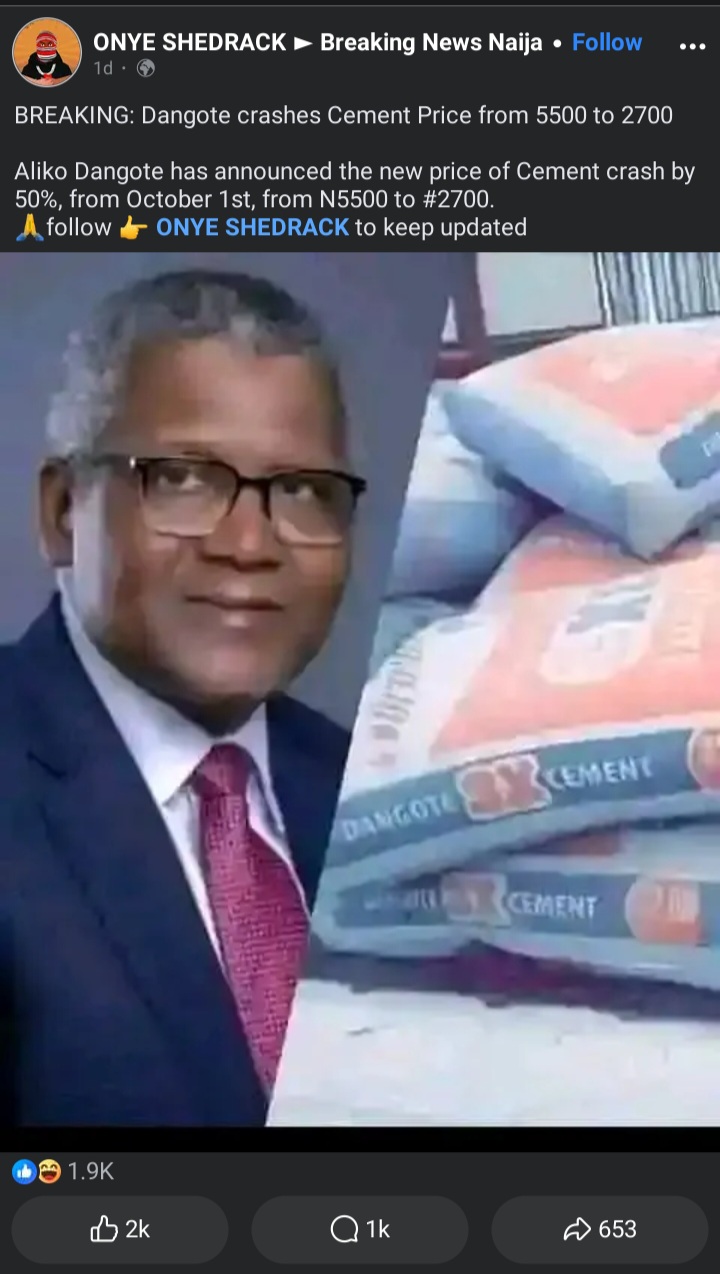
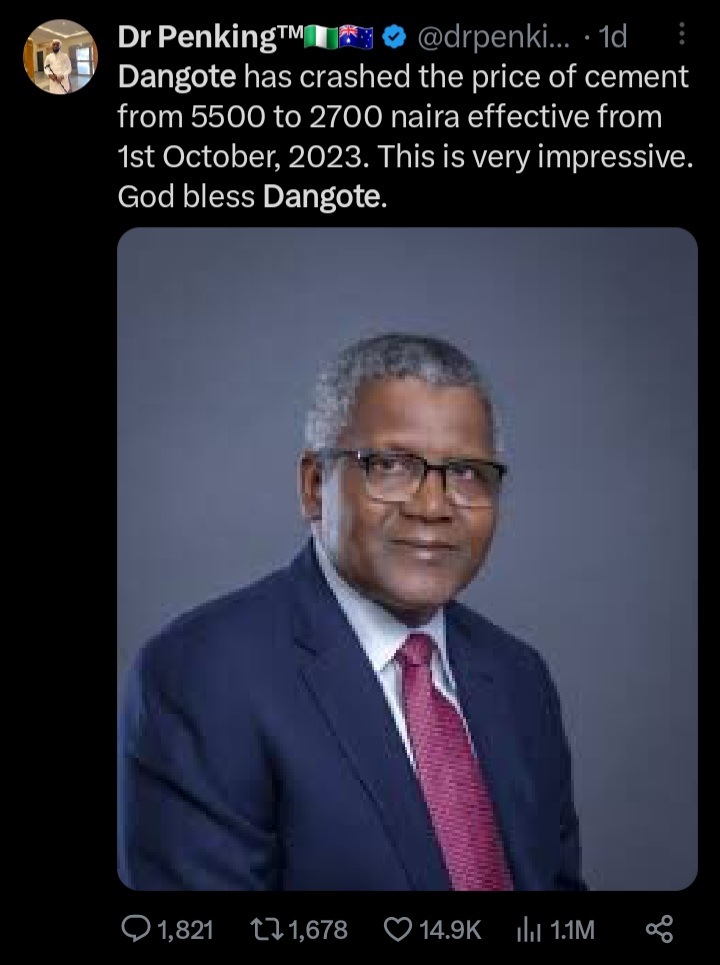
ROUNDCHECK analyzed the claim and found the claim to be incorrect
About Dangote Cement
Dangote Cement Plc, a Nigerian cement maker with its corporate office in Lagos, is a publicly traded international company. The business operates plants or import terminals in nine other African nations in addition to Nigeria, where it manufactures, prepares, imports, packages, and distributes cement and related products.
Dangote Cement has a production capacity of 48.6 million metric tons per year across ten countries.
Dangote Cement operates three production plants in Nigeria. The plants are located in Obajana, in Kogi State; Ibese, in Ogun State; and Gboko, in Benue State.
ROUNDCHECK Findings
First, to verify the claim, ROUNDCHECK went through the Dangote Cement website to search for news relating to the price reduction but could not find any news or report in that regard.
In a report published by the Daily Post, Anthony Chiejine, the spokesperson for the Dangote group disclosed that the “news was fake”.
During a visit to a retail outlet of Dangote Cement in Lafia, Nasarawa State, by ROUNDCHECK, a salesperson named Abdullahi, noted that such information had not been communicated to them from the company as he insisted the old price remained at N5,500.
Also, a search through the social media pages of the company did not show a confirmation of the claim.
Are there Cement Price Reduction Plans?
In September 2023, BUA cement company’s Chairman, Abdul Samad Rabiu, after he visited President Bola Tinubu in the Aso Rock, indicated that discussions were ongoing to reduce the price of the company’s cement from the current N5,500 to N3,000 which is a 40% reduction on the price of the product.
During Abdul’s visit, he unveiled plans by the company to reduce the price of cement produced. According to him, the reduction would only take effect after opening two plants with 3 million tons operating capacity to be commissioned at the end of the year.
The producers of BUA Cement, in a social media post, in September announced the company’s reduction of cement price. However, this reduction does not affect the products sold by Dangote Cement as they are two different companies.
Verdict
After analyzing all available records, the claim stating that Dangote Cement was set to reduce the price of the product in October 2023, from N5,500 to N2,700 is INCORRECT as at the time of writing this report.
]]>By Abidemi Akinola and Fatimah Idera
Claim
A post making rounds on Twitter has claimed that the Ondo State Government and its local government received a sum of N23.4 billion as federal allocation for the month of November and December 2022.
The claim posted by a Twitter user, @UrbanAlert on March 13, 2023, has gathered 14 likes, 11 retweets, and 2 comments as at last checked.
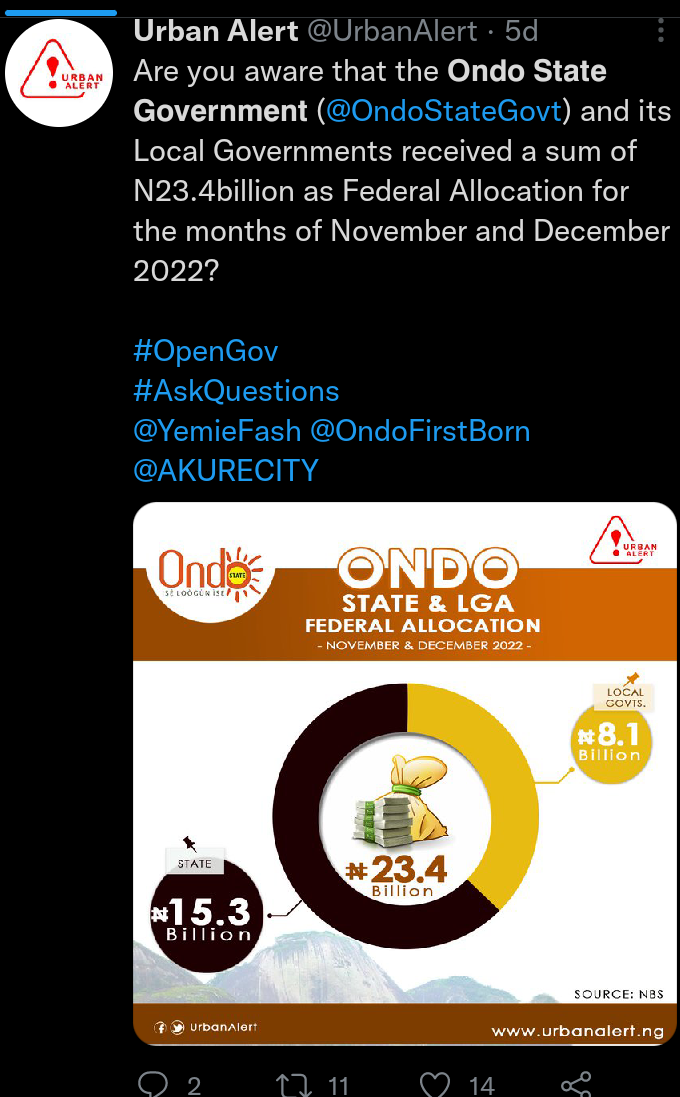
The full claim reads:
“Are you aware that the Ondo state Government (@OndoStateGov) and its local Governments received a sum of N23.4 billion as Federal Allocation for the months of November and December 2022?”
National Bureau of Statistics (NBS) is the nation’s agency in charge of the development and management of official statistics and is considered the authoritative source and custodian of official statistics in Nigeria. NBS is simply the official body of the Nigerian government that gives statistics information on the country.
Urbanalert is a non-governmental platform that identifies, investigates and alerts the authorities on social issues that affect the masses and also report the outcome of government decisions to the general public.
Also, an infographic was attached to the post attributing the source of the claim to National Bureau of Statistics (NBS) indicating that Ondo State and its local governments received a total of N15.3 billion and N8.1 billion respectively.
We checked the claim.
ROUNDCHECK Findings
ROUNDCHECK checked through the NBS portal and discovered that the Federation Account Allocation Committee (FAAC) disbursed the total amount of N957.09 billion for the month of November 2022.

The Federal Government received a total of N293.95 billion from the N957.09 billion, States and Local Governments received a total of N239.51 billion and N177.09 billion respectively for November 2022.
N26.23 billion was shared among the oil-producing states from the 13% derivation fund which Ondo State is part of.
In November 2022, Ondo State received the sum of N 6.4 billion and its local governments received N3.8 billion which means Ondo State and its local government’s overall allocation for November 2022 was N10.27 billion according to NBS.

In December 2022, The Federation Account Allocation Committee (FAAC) disbursed the sum of N1.18 trillion to the three tiers of government in December 2022 from the total revenue generated in November.
The Federal Government received a total of N358.51 billion from the N1.18 trillion, States and Local Governments received a total of N272.48 billion and N202.49 billion respectively and the sum of N68.57 billion was shared among the oil-producing states from the 13% derivation fund.
In December 2022, Ondo state received N8.8 billion and its local governments received N4.3 billion. This means Ondo state and its local government’s overall allocation for December 2022 was N13.1 billion.

For both months, the Ondo State Government received separately the sum of N15.3 billion and the local governments received N8.1 billion. Ondo and its local governments, therefore, received a sum of N23.43bn as Federation Allocation for the month of November and December.
Verdict

The claim that the Ondo State Government and its local government received a sum of N23.4 billion as Federal allocation for the month of November and December 2022 is CORRECT.
By Gbadegesin Adeyanju
Claim
Multiple social media users are making claims (here, here, and here) that Nirsal Microfinance Bank (NMFB )has opened a portal for the application of a new household grant, which is worth 100,000.
The claim stated that the grant is to finance the needs of Nigerians. Same claim was found on WhatsApp and a link to a website was attached.
We checked the authenticity of the link.

About NMFB?
Nirsal Microfinance Bank is a financial institution in Nigeria, and was incorporated in 2019, and licensed by the Central Bank of Nigeria the same year, to carry out specialized banking services. It is an intervention bank that on-lends special funds from the Central Bank of Nigeria to qualified citizens.
NMFB is a National Microfinance Bank with 115 branches in all the states across Nigeria with its headquarters in Abuja.
ROUNDCHECK Findings
To check the authenticity of the claim, we visited the website attached to the claim.
The link was directed to a webpage to register, but one could click on the apply button without entering any information. After the whole process, the page was redirected to another website where users are expected to enter bank details.
Again, clicking on “bank details” redirected me to yet another different website with blog posts.
ROUNDCHECK did a quick research with “scam adviser” and “whois” (tools used in verifying information webpages) about the website.
During the search, we observed that the identity of the owner is hidden, the registrar of the website is popular amongst scammers, and the website looks to be hosted by a shady service provider.
According to the Scamadviser, the trust score of the website is one percent, which is very low to be trusted.
ROUNDCHECK visited the official website of the bank and social media pages but didn’t find any information related to the claim. It was also observed that the bank has flagged the claim as SCAM on their Facebook page.

Few weeks after these findings, we observed that the link to the website became unreachable. An indication that the website is fake.
Verdict
The claim that Nirsal Microfinance Bank (NMFB) has opened a portal for the application of new Household Grant of N100,000 to finance Nigerians’ needs is not authentic. It is a HOAX created to steal unsuspecting users’ information.
]]>Nigerian former minister of Education, Obiageli Katryn Ezekwesili, has claimed that the former Vice President of Nigeria, Atiku Abubakar did not head the Economic Management team during his tenure as Vice President.
She made the claim on her Twitter handle on January 17 2023 after the former VP asserted that he was once the head of the Economic Management team during his time as the Vice President of Nigeria.

The full text of her tweet reads:
“Dear former Vice President Atiku, please ask the handlers of your Twitter account to stop misleading the public. You were never the head of the Economic Management Team
“This absurd Lie does no good at all. Please ask your team to stop it. Happy New Year. Wish you well.
Atiku had earlier made a tweet where he referred to himself as ‘head of the economic management team’ during his period as VP of Nigeria.
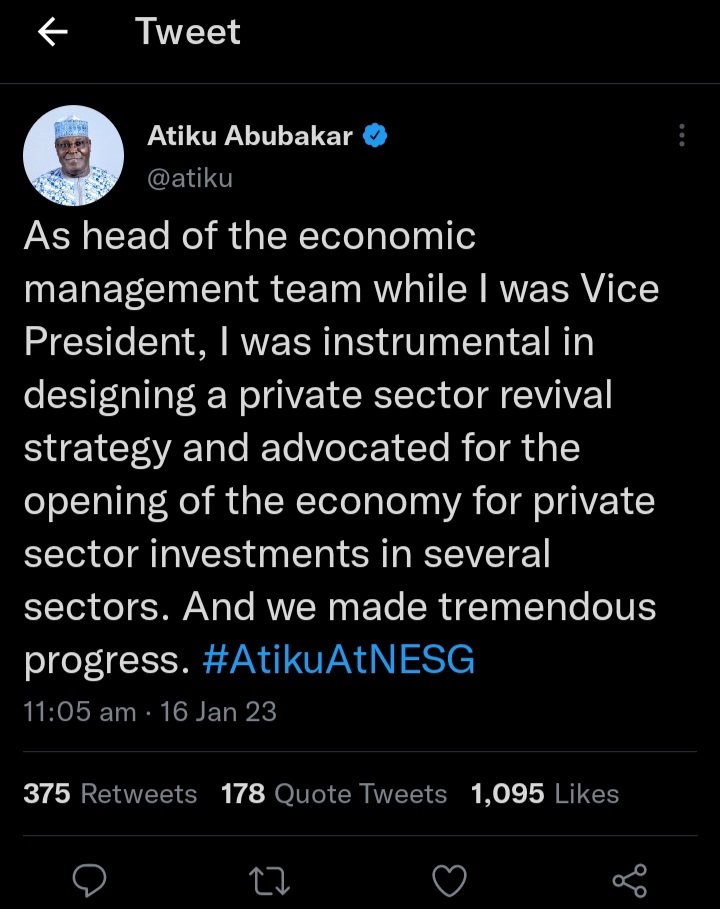
The full text of Atiku’s tweet reads:
“As head of the Economic Management Team, while I was Vice President, I was instrumental in designing a private sector revival strategy and advocated for the opening of the economy for private sector investment in several sectors. And we made tremendous progress”
Who is Ezekwesili?
Obiageli Katryn Ezekwesili is a former Vice President for the World Bank’s Africa region, a co-founder and founding director of Transparency International, a co-founder of the #BringBackOurGirls movement, and has served twice as Federal Minister in Nigeria.
Ezekwesili is an economic policy expert, an advocate for transparency, accountability, good governance, and human capital development, a humanitarian, and an activist.
She is also the founder of #FixPolitics Initiative, a research-based citizen-led initiative, the School of Politics, Policy and Governance (SPPG), and Human Capital Africa.
Who Is Atiku Abubakar?
Atiku Abubakar politician and businessman who served as the Vice President of Nigeria from 1999 to 2007 during the Olusegun Obasanjo administration.
He ran as governor of Adamawa State in 1990, 1996, and later, in 1998, being elected before becoming Olusegun Obasanjo’s running mate during the 1999 presidential election and being re-elected in 2003.
In May 2022, he was chosen as the Peoples Democratic Party presidential candidate for the 2023 general election after he defeated Nyesom Wike who is the current Governor of Rivers State in the primaries, and other contestants which include: Former Senate President, Bukola Saraki; Former Secretary to the Government of the Federation, Anyim Pius Anyim; Bauchi State Governor, Bala MohaIbom; Udom Emmanuel, the Governor of Akwa Ibom; Dele Momodu; Ayo Fayose, former governor of Ekiti State; Charles Ugwu; Chikwendu Kalu; Tarella Diana and Sam Ohuabunwa.
ROUNDCHECK Findings
In our first findings, we referred to the Nigerian 1999 Constitution to establish the facts regarding the creation of the Economic Management team and its leadership.
Findings revealed that the 1999 Constitution of the Federal Republic of Nigeria does not have a provision for an Economic Management team.
Rather, The National Economic Council (NEC) was established by the provisions of the Constitution of the Federal Republic of Nigeria, 1999, as amended; Section 153(1) and Paragraphs 18 & 19 of Part I of the Third Schedule.
The NEC is chaired by the Vice President.
ROUNDCHECK also discovered that the Economic Management team was an initiative of President Olusegun Obasanjo in 2003 to tackle the economic challenges of Nigeria.
We went further to check records regarding the leadership of the Economic Management team as appointed by Olusegun Obasanjo.
According to the Centre for Africa-Europe relations the former World Bank director, Ngozi Okonjo-Iweala was the head of the economic management team, other members include Chukwuma Soludo, a former governor of the Central Bank of Nigeria (CBN); Nuhu Ribadu, chairman of the Economic and Financial Crimes Commission (EFCC) then; Nasir el-Rufai, minister of the Federal Capital Territory (FCT) then; Oby Ezekwesili, Minister of Education, Bode Agusto, director-general of the Budget Office, and Ifueko Omoigui chairman, Federal Inland Revenue Service (FIRS).
The National Economic Council (NEC) which is stipulated in the Constitution of the Federal Republic of Nigeria and chaired by the Vice President, is different from the Economic Management team.
Obasanjo, Yar’adua, Jonathan, and Buhari’s Economic Management Team.
In 2003, President Olusegun Obasanjo’s Economic Management Team was headed by Ngozi Okongo Iweala, while his successor, President Yar’adua, after his election in 2007 appointed his Vice, Goodluck Ebele Jonathan as head of the Economic Team.
President Jonathan, following the footsteps of his predecessor, named Vice President Namadi Sambo to lead his Economic team.
In 2019, President Muhamadu Buhari replaced Vice President Yemi Osibanjo as head of the Economic Management Team with an Economic Advisory Council, which is headed by Professor Doyin Salami.
Although Vice President Yemi Osibanjo is listed as the head of the Economic Management Team on the state house website (as at the time of this report)- this contradicts the appointment of Professor Doyins Salami’s led Economic Advisory Council.
Meanwhile, it is worthy of note that some administrations use different terms for its economic team- Economic Management Team, Economic Advisory Team and National Economic Council.
However, ROUNDCHECK could not trace any record of Atiku Abubakar heading the Economic Management Team during his period as Vice President of Nigeria (1999–2007).
Verdict
After checking available records, the claim made by former Nigerian Minister Ngozi Obiageli Ezekwesili stating that Atiku Abubaker did not head the Economic Management team is correct.
Hence, the claim counters that of former Nigerian vice president and 2023 presidential candidate Atiku Abubakar, who claimed he headed the Economic Management team during his time as the Vice President.
We, therefore, conclude that Atiku Abubakar might have headed the Economic Council as the Constitutional duty of a VP, but not the Economic Management team.
The African Action Congress(AAC) presidential candidate, Omoyele Sowore, made several claims during “The Candidate” Debate in November 2022.
Some of these claims were analyzed by the Coalition of Nigerian Fact-checkers and a verdict was given. We did a compilation of some of the claims, the findings and the verdicts.
Omoyele Sowore In View
Omoyele Sowore is a Nigerian human rights activist and pro-democracy campaigner, known for founding the online news agency Sahara Reporters. In 2018, he founded the African Action Congress party and ran as its presidential candidate in the 2019 Nigerian general election. Sowore is also running for president in the 2023 Nigerian general election.
Here are the top findings.
Claim 1
CLAIM: Mr Sowore, the presidential candidate of the AAC claimed that based on official figures, oil companies owe Nigeria $6.4billion
FINDINGS: News reports by ThisDay and The Cable in September 2022 quoted Ogbonnaya Orji, the Executive Secretary and National Coordinator of the Nigeria Extractive Industries Transparency Initiative (NEITI), as saying the outstanding taxes and fees from the oil companies as of March 2022 is $2.674 billion, not $6.4billion which was the figure in 2019.
VERDICT: FALSE
SOURCE: NEITI
Claim 2
CLAIM: Mr Sowore said all countries that are doing well economically, their citizens usually don’t use guns.
FINDINGS: We used two countries with high GDP per capita to fact-check this claim. For instance, the US has a GDP per capita of $69,287, it has a gun per citizen rate of 120.5 per 100 people.
Canada has a GDP per capita of $52,051 and a gun per citizen rate of 34.7 citizens per 100 persons.
On the other hand, Nigeria’s GDP per Capita is $2,085, and has a gun per citizen rate of 3.2 per 100 persons.
VERDICT: FALSE
SOURCE: World Bank
In a follow-up comment, he said he meant that prosperous countries do not need arms to ensure security and that the United States should not be used as a measure of prosperity.
Claim 3
CLAIM: Mr Sowore said that Lake Chad shrunk to 10 percent of its original size
FINDINGs: Multiple records, updated up till 2019, show that once one of Africa’s largest lakes, Lake Chad has shrunk by around 90 percent since the 1960s.
VERDICT: CORRECT

SOURCE: European Space Agency, United Nations Department of Economic and Social Affairs (UNDESA).
Claim 4
CLAIM: Mr Sowore said Nigeria has “more women qualified to vote than men.”
FINDINGS: News reports by ICIR Nigeria on the 2nd of July 2022 and recently by the Punch on the 2nd of August 2022 show that there are more women than men who have been registered by INEC to vote in the 2023 elections.
VERDICT: CORRECT
SOURCE: The ICIR and Punch, referencing INEC
EDITOR’s NOTE: These fact-checks were done by the coalition of Nigerian fact-checkers during the live presidential debate. ROUNDCHECK only did this compilation and reproduced for publication.
]]>Multiple online reports titled ‘USA Moves to Checkmate Dollar Stockpile in Africa’ [227-word] and attributed to Reuters were widely circulated on social media claiming that by January 31, 2023, the United States dollar notes issued before 2021 will no longer be accepted as legal tender.
The report was massively shared on social media platforms like WhatsApp, Facebook, and Twitter. Mustapha Gembu, a blogger and Facebook influencer posted the claim on the 5th of November, his post got 495 likes and was shared widely by 367 users. And a Twitter user, @yinkus772003 also tweeted the claim, her tweet got 241 likes and was retweeted by 181 users.
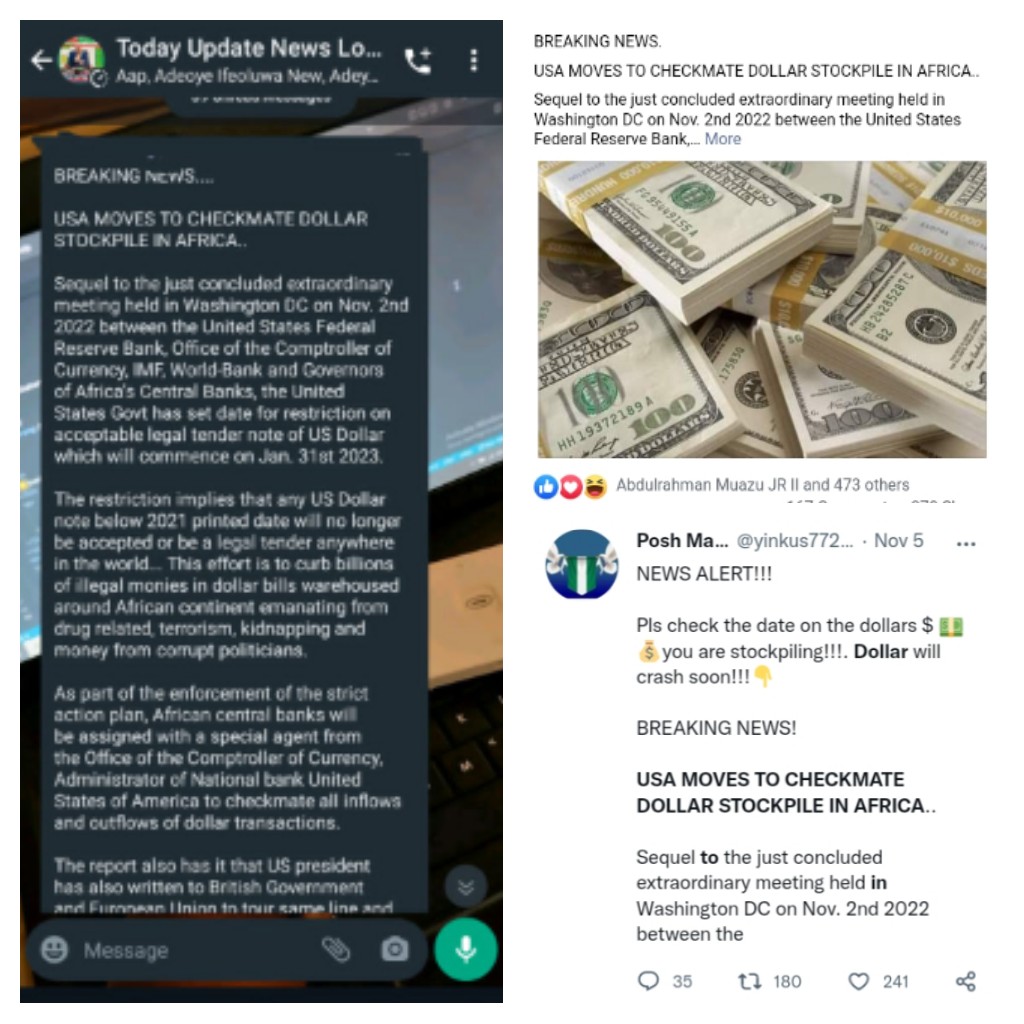
The report claims that the government of US “has set a date for restriction on an acceptable legal tender note of US Dollar which will commence on Jan. 31st, 2023”.
“The restriction implies that any US Dollar note below the 2021 printed date will no longer be accepted or be a legal tender anywhere in the world… This effort is to curb billions of illegal monies in dollar bills warehoused around African continent emanating from drug-related, terrorism, kidnapping and money from corrupt politicians,”
“Should this action be implemented come January 2023 as reported, Nigerian corrupt politicians will be worse hit.” the report reads.
The claim is coming over a week after the Federal Government of Nigeria announced the redesign of some naira notes. On October 26, the Governor of the Central Bank of Nigeria (CBN), Godwin Emefiele said the apex bank would issue redesigned N200, N500, and N1,000 notes, effective December 15, 2022, while the new and existing currencies will remain legal tender and circulate together until January.
According to the Governor, some factor that influenced the redesign of the naira notes is the “significant hoarding of banknotes by members of the public”. He added that statistics show that “over 80 percent of currency in circulation are outside the vaults of commercial banks”.
ROUNDCHECK Findings
ROUNDCHECK conducted a keyword search on the claim and found that the claim appeared in several online blog sites like The Heritage Times, The News Nigeria, and also on Nairaland, a well-known social networking platform in Nigeria, all entitled “USA moves to checkmate dollar stockpile in Africa”.
However, ROUNDCHECK observed that the source of the several reports was attributed to Reuters – one of the largest news agencies in the world established in London in 1851 by the German-born Paul Reuter.
We searched the Reuters news website using related keywords and terms. Reuters published no such story.
ROUNDCHECK also checked the official website of the US Department of the Treasury, the National Finance and Treasury Office of the federal government, and there were no announcements related to the claim.
Further checks also revealed that no reputable news media, both in the US and Nigeria published reports on dollar redesign.
Meanwhile, information via the US Federal Reserve Board website reveals that the US currently issues seven denomination of dollar notes, which includes $1, $2, $5, $10, $20, $50, and $100
And according to information available on the website of the US Currency Education Programme, the current design of the $100 note, issued on October 8, 2013, is the latest denomination to be redesigned.
The US Currency Education Programme (CEP) which provides education, training, and information about federal reserve notes emphasizes that “it is U.S. government policy that all designs of U.S currency remain legal tender, regardless of when they were issued”.
The US CEP added that the policy includes “all denominations of federal reserve notes, from 1914 to the present”.
It further stated that “All U.S. currency issued since 1861 is valid and redeemable at its full face value.”
We also observed that the claim has been checked by other fact-checking newsrooms here.
Verdict
Findings by ROUNDCHECK reveal that neither Reuters nor other credible media reported such news on the alleged “USA moves to checkmate dollar stockpile in Africa”.
Similarly, the official web portal of the United States federal government and the Federal Reserve – the central bank of the United States did not make any announcement or publication about the claim.
Therefore, the claim that the United States has redesigned dollar notes and will reject all old notes from January 2023 is INCORRECT.