




|
Getting your Trinity Audio player ready...
|
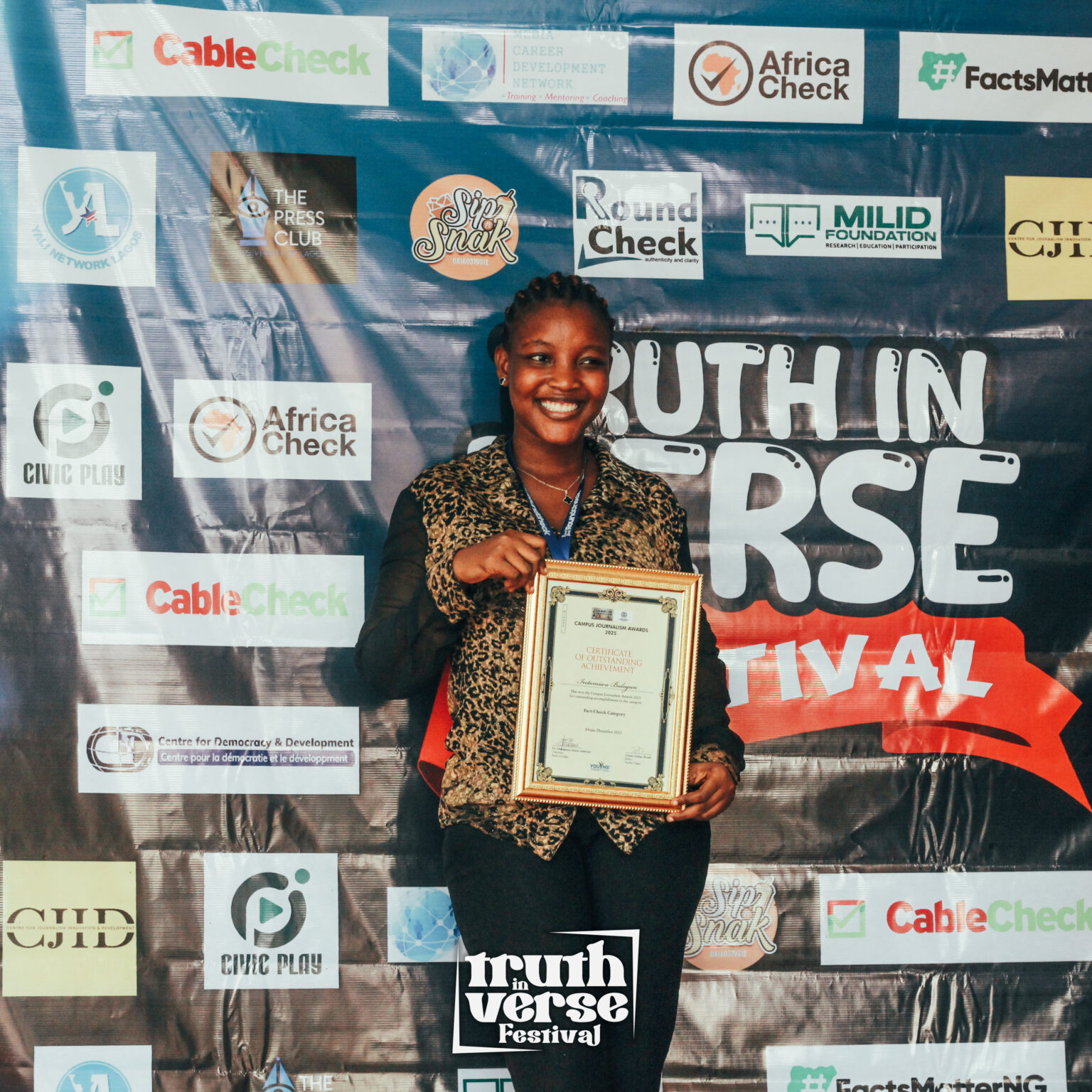
Campus journalist and ROUNDCHECK’S gender researcher, Iretomiwa Balogun, has added another achievement to her growing career after winning the maiden Fact-Check Category and finishing as runner-up in the Gender Reporting Category at the 7th Campus Journalism Awards (CJA) held on 6th December, 2025, at Transcorp Hilton, Abuja.
Both entries were published under ROUNDCHECK’s Gender Disinformation desk, and have now earned her recognition not only in Nigeria but also across the continent. In October, at the 2025 African Check Awards in Senegal, her pregnancy-test fact-check report emerged runner-up, making it her first continental honour.
Her fact-check report, ‘Exposing Social Media Claim That Any Liquid Can Make a Pregnancy Test Strip Turn Positive‘, debunked a viral rumour suggesting that liquids such as soda, detergent water, or soap could produce a false positive result. The myth had circulated widely on social media and was influencing many young people, becoming a casual reference point in conversations about pregnancy.
The story stood out due to its evidence-driven reporting. Iretomiwa conducted a controlled test, compared outcomes, and spoke with medical experts who explained how pregnancy test strips work. They clarified that test kits detect hCG levels in urine, not the chemical composition of random liquids. The report cut through a popular misconception that had shaped online discussions and misled thousands.
It was this same investigation that placed her as runner-up at the Africa Awards, where the judges highlighted its public-health value and the clarity of her evidence-based approach.
More Read

Her second recognised work, the gender-based violence report, Femicide Denials Raise Concerns With Increased Cases In 2024, explored the widespread denial of femicide in Nigeria. The story examined how cultural norms, misinformation, and silence often cloud conversations around gender-motivated killings. Through interviews with gender experts, advocates, and groups tracking femicide numbers, she showed how patriarchal attitudes shape public reactions and sometimes even shift blame onto victims.
The report documented cases responsibly, emphasising what they reveal about justice, safety, and institutional accountability.
In the days leading up to the ceremony, Iretomiwa said she felt both excited and uneasy. She had hoped to travel to Abuja for the event but was unable to due to security concerns.
“I was excited, but not completely happy because I couldn’t travel to Abuja for the ceremony. I really wished I was there physically to experience it,” she said.
Hearing her name announced as the Fact-Check winner was a moment of joy. But the Gender Category runner-up hit her differently. The femicide denial report had taken an emotional toll, and its recognition felt meaningful in a deeper way.
“Winning the Fact-Check Category felt good, but the Gender Category recognition moved me more. That femicide denial story meant a lot to me. It felt like an issue that was being buried, so seeing it recognised gave it the visibility it deserved.”
For Iretomiwa, the awards are both encouragement and responsibility. As a final-year student, this is the last time she will contest in a student category, and she believes future nominations will place her directly among professionals.
Throughout her reporting process, she had strong editorial guidance from ROUNDCHECK. Still, securing expert interviews remained the toughest part.
“Experts are usually busy, so getting them to speak was the most difficult part,” she said. “Apart from this, I would not really say I had challenges since I had guidance from people like Mr Adesola, the Editor at ROUNDCHECK and Mr Caleb, the Executive Director.”
For the fact-check report, she hopes readers learn to verify claims and stop spreading recycled falsehoods. She shared how she still meets people who believe household substances can influence pregnancy-test results.
Her femicide denial report sits closer to her heart. She is troubled by the number of unresolved cases and the persistent dismissal of gender-motivated killings.
“Many cases go unresolved and voices get buried. I hope the story pushes authorities to do what’s needed to end this menace.”
As she prepares to enter the professional space fully, Iretomiwa’s focus is on growth. She is intentional about expanding her knowledge and refining her instincts.
“Every review from editors teaches me something I didn’t consider. I want my reporting to spur action.”
More than anything, she wants her work, especially in gender reporting, to drive conversations, shift attitudes, and move people towards action.
With recognitions from the CJAs and the Africa Fact Awards now shaping her resume, she steps into the next phase of her journalism career with a strong foundation and an even stronger resolve to tell stories that matter.



