



|
Getting your Trinity Audio player ready...
|
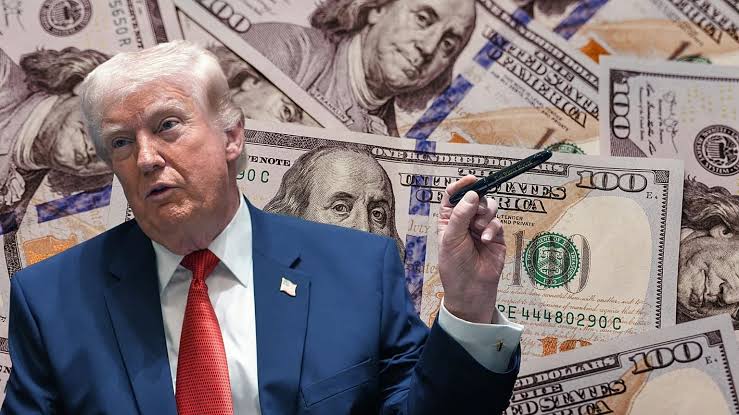
With the 2026 US midterm elections drawing closer, President Donald Trump has made an eye-catching promise to Americans: a $5,000 “dividend” for every adult citizen if Republicans win control of both chambers of Congress.
The announcement, made at the Republican Party’s midterm convention in Dallas, Texas, quickly drew attention.
While supporters applauded the prospect of receiving thousands of dollars, questions emerged over where such a huge sum would come from, whether Trump has the authority to make the payments, and whether the promise can actually be fulfilled.
With roughly 270 million adults in the United States, the proposed payout could cost the federal government well over $1.3 trillion. Vice President JD Vance has suggested that revenue from Trump’s tariffs could fund the payments, but no detailed funding or implementation plan has been announced.
So, is Trump really offering $5,000 to every American adult? Why is he making the promise, and can the “Trump Dividend” actually become reality?
More Read

ROUNDCHECK broke down what was promised, how it might be funded, and what would have to happen before Americans could see any money.
What Exactly Did Trump promise?
Speaking at the Republican Party’s midterm convention in Dallas on the night of September 9, 2026, Trump said that if Republicans keep control of both the House of Representatives and the Senate in the November midterms, he would issue a $5,000 dividend to every adult US citizen.
Trump also said the money would have to be spent inside the United States rather than taken abroad, naming Canada, China, and Germany as examples, though he did not explain how such a rule would be enforced.
This remains a political promise, not an existing government programme. No federal law has been passed creating the payment, and no American has been approved to receive it.
Why Is Trump Making The Offer?
The midterm elections are scheduled for November 3, 2026, and Trump’s Republican Party is fighting to hold on to Congress. Historically, the president’s party tends to lose seats in midterms, and current polling and projections favour Democrats to retake the House, an outcome that would sharply limit what the administration could pass legislatively for the rest of Trump’s term.
The dividend promise, made on the opening night of the first-ever Republican midterm convention, is widely read as an attempt to energise voters ahead of that risk.
The proposal also lets Trump frame his tariff-driven economic agenda as something that pays ordinary Americans directly, rather than as an abstract trade policy.
Where Would The $5,000 Come From?
Trump has not laid out a funding mechanism. Vice-President JD Vance has pointed to revenue from Trump’s tariffs on imported goods as the likely source, arguing that tariff collections have brought in substantial money that could eventually be returned to Americans as a dividend.
But tariff revenue and money legally available for direct payments are not the same thing.
Tariffs are taxes on imports, and their cost is often passed on to businesses and consumers through higher prices.
Even sizable tariff collections don’t automatically translate into funds the government can legally distribute as $5,000 checks; that would still require congressional appropriation.
How Much Would The Offer Cost?
At roughly 260 to 270 million adult citizens and $5,000 each, the total comes to somewhere between $1.3 and $1.35 trillion, a figure multiple outlets, including CNBC, have independently put at “more than $1 trillion.”
That makes it far larger than most federal transfer programmes and raises real doubts about whether tariff revenue alone could cover it.
Does Trump Have The Power To Simply Send Americans $5,000?
Congress controls federal spending, so a nationwide payment programme of this size would need congressional authorisation.
Reactions within Trump’s own party show the divide this creates: Ohio Senator Bernie Moreno publicly endorsed the idea and said he would draft legislation to enact the dividend after the election, while Texas Congressman Chip Roy was openly sceptical, questioning how Republicans would pay for a plan that could cost “well over $1 trillion.”
Trump himself has not said whether or how he would formally ask Congress to approve it.
Is The Proposal Legal?
US federal law makes it a crime to offer money as an inducement tied to how someone votes, punishable by a fine or up to a year in prison, with willful violations carrying penalties of up to two years.
That has raised questions about whether the dividend pledge could run afoul of election law.
However, Trump’s statement doesn’t explicitly say people must vote for him or Republicans to get the money; his stated condition is that Republicans must win control of Congress, not that any individual voter cast a particular ballot.
Some legal analysts argue that framing makes it more defensible as a campaign promise about future policy rather than a direct payment for votes. Others aren’t convinced, and CNBC has reported it sought comment from the White House on whether the plan could violate those provisions.
Ultimately, the legality would likely hinge on how or whether Congress eventually wrote it into law.
Is This The First Time Trump Has Promised Americans Money Like this?
No. This is at least the third time in roughly a year that Trump or his allies have floated a large direct payment funded by tariffs or spending cuts:
Earlier in his second term, Trump backed a “DOGE dividend” of $5,000, an idea originally floated by Elon Musk as a way to return savings from Department of Government Efficiency budget cuts to taxpayers.
Trump said he liked the idea, but it was never implemented.
In November 2025, Trump promised a dividend of “at least $2,000 a person,” funded by tariff revenue, would materialise “in the coming months.” That also never happened.
Separately, more than a million military service members did receive a one-time $1,776 “warrior dividend” in early 2026, but that payment came from a specific, congressionally approved military housing supplement, not a broad tariff dividend, and isn’t really comparable in scale or mechanism.
That track record, two prior tariff-funded dividend promises at $5,000 and $2,000, neither of which materialised, is the key reason analysts are treating the new $5,000 pledge as unproven until Congress acts.
Why Does Trump Call At A “Dividend”?
Trump and Vance are framing the payment as a return of money generated by tariff policy, comparing it to a company distributing profits to shareholders, rather than describing it as a stimulus check or welfare payment.
That framing ties the payment directly to Trump’s “America First” economic message rather than to pandemic-era-style relief spending.
What Are The Biggest Unanswered Questions?
- Who exactly qualifies? Trump said “every adult citizen,” but no detailed eligibility rules have been released.
- Would high-income Americans get it too?
- How would the money actually be distributed?
- Would Congress pass the necessary legislation, and would it survive if Democrats win the House?
- Is tariff revenue actually sufficient to cover $1.3 trillion-plus?
- Could a payment this large add to inflation or consumer prices?
- How, if at all, would the government enforce the “must be spent in the US” condition?
- If approved, when would Americans actually receive the money?
Conclusively, ROUNDCHECK understands that Trump has promised a $5,000 “dividend” to every adult US citizen if Republicans win both chambers of Congress; however, the payment, mode and source of the money aren’t publicly available.



