




|
Getting your Trinity Audio player ready...
|
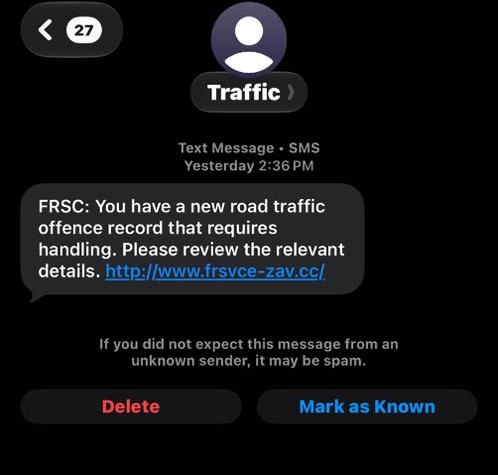
Zaynab, just like everyone in Lagos, was going through her normal day when she received a text message allegedly from the Federal Road Safety Corps (FRSC), informing her of a new traffic offence record that requires her attention.
The message asked that she review relevant details by clicking a link.
She paused for a second and wondered why she received this message, knowing she doesn’t own a car.
“I laughed and wondered why I should click the link when I don’t even own a car. It is clearly bizarre,” she told ROUNDCHECK.
ROUNDCHECK observed that many Nigerians also received this link; While Zaynab was able to decipher that it was a scam, others fell victim, losing millions of naira.
More Read

Nigerian comedian, Edeh Chisom, popularly called MC Monica, said he fell victim to the FRSC scam. According to him, he proceeded to pay a #5000 after receiving the text message, and what followed was a deduction of over a ‘million naira (#1,849,378)’ from his account.
Also, Actor Adekanla Desalu said he lost $2,500 after paying #2,500 through the FRSC scam link.
Although the FRSC debunked the claim days later, the impact had already been felt.
The FRSC noted that the scam message was designed to impersonate the digital identity of the Federal Road Safety Corps. “The Corps therefore unequivocally disowns the messages and the website, stressing that members of the public should not regard such communications as originating from FRSC,” the agency said.
Scammers continue to target unsuspecting members of the public using phishing links combined with emotionally crafted messages. In some cases, these messages are crafted around people’s day-to-day activities, making them appear credible and increasing the likelihood of victims falling for the scams.
How Did The FRSC Scam Work?
Members of the public received several text messages on their phones purportedly from FRSC, a regulatory agency responsible for the administration of traffic laws and regulations in Nigeria.
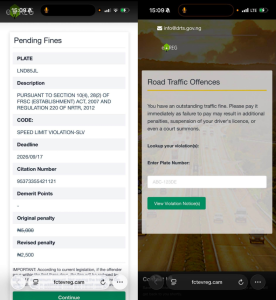
The messages informed recipients of a traffic offence and asked them to click a link to view details. The tactic was to take them to a separate website where they would be required to pay and fill in some details.
ROUNDCHECK observed that the website links received by recipients differ. Some of the links are www.fctevreg.cam/z, www.frsvce-zac.cc, www.frscc-zgh.cc, and are no longer accessible.
How Not To Fall Victim To Online Scams
Online scams are targeted at Susceptible members of the public, using relatable messages and emotion-driven statements to steal their personal information, money, and, in some extreme cases, cause harm to them.
Sometimes, they pose as recognised government agencies or institutions that members of the public interact with. To be safe, ROUNDCHECK has provided practical ways not to fall victim to these scams, just like the FRSC messages received by several Nigerians.
1) Don’t be forced to click; read again: The first thing that comes to mind when you see a message that speaks to your emotions is for you to click. Resist the urge to, and take your time to read again. Read the message again carefully to understand the context, the sender, and why you should be receiving that message. Bad actors will want you to click a scam message that has been crafted to appear emotional to you; do not click. Read it again, and again. One click can cause a lot of damage and expose you to risk.
2) Check the sender of the message and other information in it: Critically examine the sender of the message and other information included in it. This could include the name of the institution (Is it correctly written?), or even the website link attached in the message (Is this the verified website address of the organisation?). Check for errors in the sentences and use of punctuation. A recognised institution is unlikely to make sentence errors in its official messaging. Asking these questions can help protect you from getting scammed.
3) Conduct a keyword search: A keyword search on Google can reveal a lot of information about the message you’ve received. In the case of the FRSC message, a keyword search would be “ FRSC traffic offence link” or “FRSC traffic offence” or “FRSC traffic offence payment”. This will reveal the original website of the FRSC, traffic offence link, if any, and other related information of the FRSC that can help you make a decision.
4) Check the website domain: Most scam websites try to replicate the websites of an authentic organisation; however, some of the details are always different. Details like the URL spelling and the domain name are false if you check closely. Most authentic organisations will use familiar domain names like .com, .com.ng, .org.ng, .org, while government agencies in Nigeria use .gov.ng. It is important you check the spelling of these websites’ URLs and cross-check the domain.
5) Check reputable platforms: Checking through reputable platforms – including media organisations and social media – can help you know if the message or information is authentic. When you see a message telling you to click a link or promise financial rewards, your next step should be to check reputable news platforms and also verified social media handles of the organisation to confirm if the information is authentic.
6) Reach out to experts to confirm: When in doubt or uncertain about information you receive, your next step will be to reach out to experts who can help confirm if the information you’re about to act on is authentic. Experts could include fact-checking organisations (Like ROUNDCHECK), the contact number of the organisation, a financial expert, amongst others. Don’t make a decision based on half knowledge.
Conclusion
Online scams promise financial rewards for little or no effort, and most times are fuelled by emotionally charged messages. Checking a website or information thoroughly before acting on it will save you from getting scammed, data loss, and exposing yourself to danger.



