




|
Getting your Trinity Audio player ready...
|
Media leaders have urged journalism students to embrace digital innovation without compromising the profession’s ethical standards, stressing that the future of journalism depends on adapting to technological change while maintaining credibility and public trust.
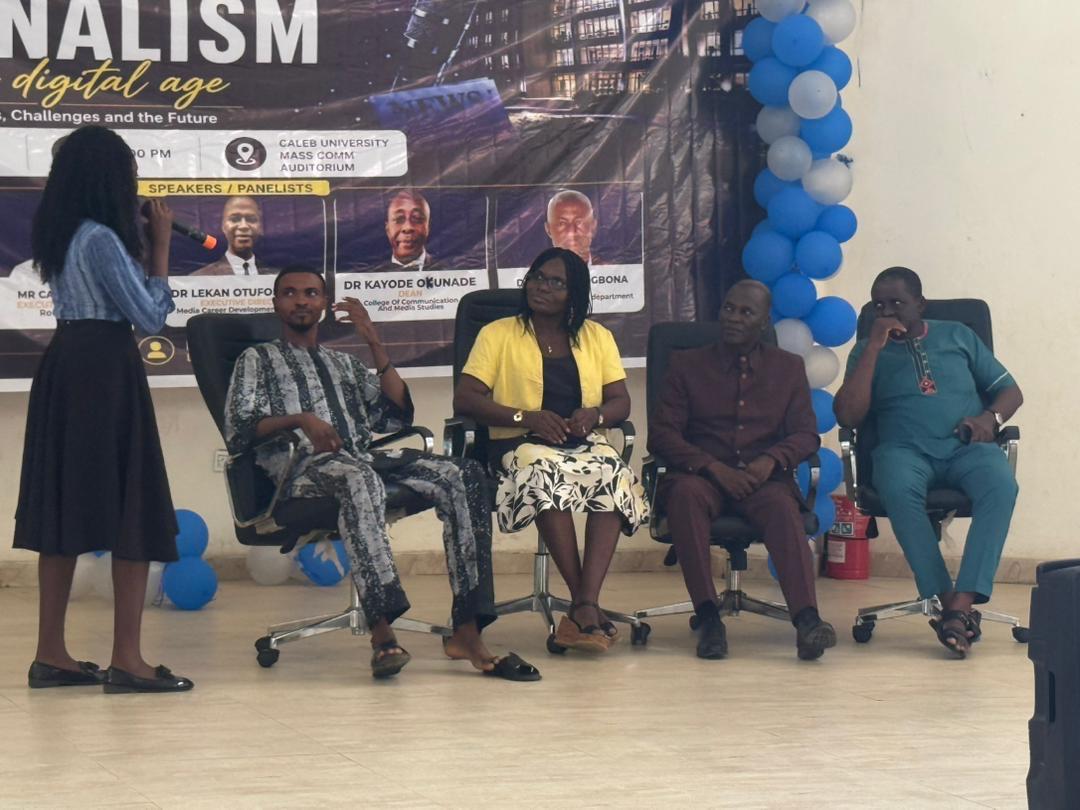
The call was made during a high-level conversation on “Journalism in the Digital Age: The Prospects, Challenges and the Future,” organised by the Department of Mass Communication, Caleb University, on Tuesday, July 7, 2026.
The event brought together students, academics and media professionals to examine how digital technologies are transforming journalism, reshaping audience behaviour and redefining newsroom operations.
Speakers included the Managing Editor of Independent Newspapers Limited, Kingsley Ighomwenghian; Executive Director of ROUNDCHECK, Caleb Ijioma; and Executive Director of the Media Career Development Network, Lekan Otufodunrin.
Also in attendance were the Dean of the College of Communication and Media Studies, Dr. Kayode Okunade; the Head of the Department of Mass Communication, Dr. Sunday Ogbonna; Senior Lecturer, Dr. Oluwafisayo Ogunyemi; alongside other faculty members, including Dr. Solomon Oyeleye, Dr. Charles Adewale, Dr. Samson Bello, Mrs. Joy Joseph, Mr. Stephen Ajagbe, Mr. Iskeelu Jolaoso and Mr. Tunji.
More Read

Speaking on “Navigating Digital Journalism: Prospects, Challenges and the Future,” Kingsley Ighomwenghian said digital technology has transformed journalism, creating new opportunities for storytelling, audience engagement and access to information.
He noted that websites, social media, podcasts and newsletters have enabled journalists to reach wider audiences while providing independent newsrooms with greater opportunities to publish without relying solely on traditional media channels.
Kingsley warned that the speed of digital publishing has intensified pressure on journalists to report quickly, making verification and accuracy more critical than ever.
Speaking on “Fact-checking in Investigative Journalism,” Caleb Ijioma said that investigative journalism plays an important role in exposing wrongdoing, fighting corruption, and holding those in positions of authority accountable, while fact-checking ensures that every claim is verified using credible sources, publicly available information, and digital verification tools before publication.
Ijioma encouraged students to cultivate strong research and verification habits, stressing the importance of documentary evidence, data analysis and interviews in producing accurate and impactful investigative reports.
Otufodunrin, while delivering a presentation on “Managing Media Organisations in the Age of Digital Disruption,” said technological advancement has fundamentally changed how media organisations produce, distribute, and monetise content.
He explained that the media is no longer confined to newspapers, radio or television, as most organisations now operate across multiple platforms, including websites and social media, to meet changing audience expectations.
According to him, media organisations must rethink their traditional management structures to remain competitive in the digital era. He urged media managers to understand the realities of digital disruption, invest in multimedia facilities, equip journalists with cross-platform skills and adopt management approaches that reflect the demands of an increasingly digital media landscape.
Throughout the discussions, the speakers agreed that while technology will continue to reshape journalism, the profession will remain relevant only if journalists uphold the principles of accuracy, fairness, verification and accountability.
Lecturer in charge, Funmi Falobi, noted that the event formed part of the department’s efforts to expose students to emerging trends in journalism and prepare them for the realities of an increasingly digital media industry.
According to her, technological disruption has transformed the industry, and it has also created opportunities for innovation.
Highlights of the event include a spoken word recitation and stage drama on the impact of disinformation.



