




|
Getting your Trinity Audio player ready...
|
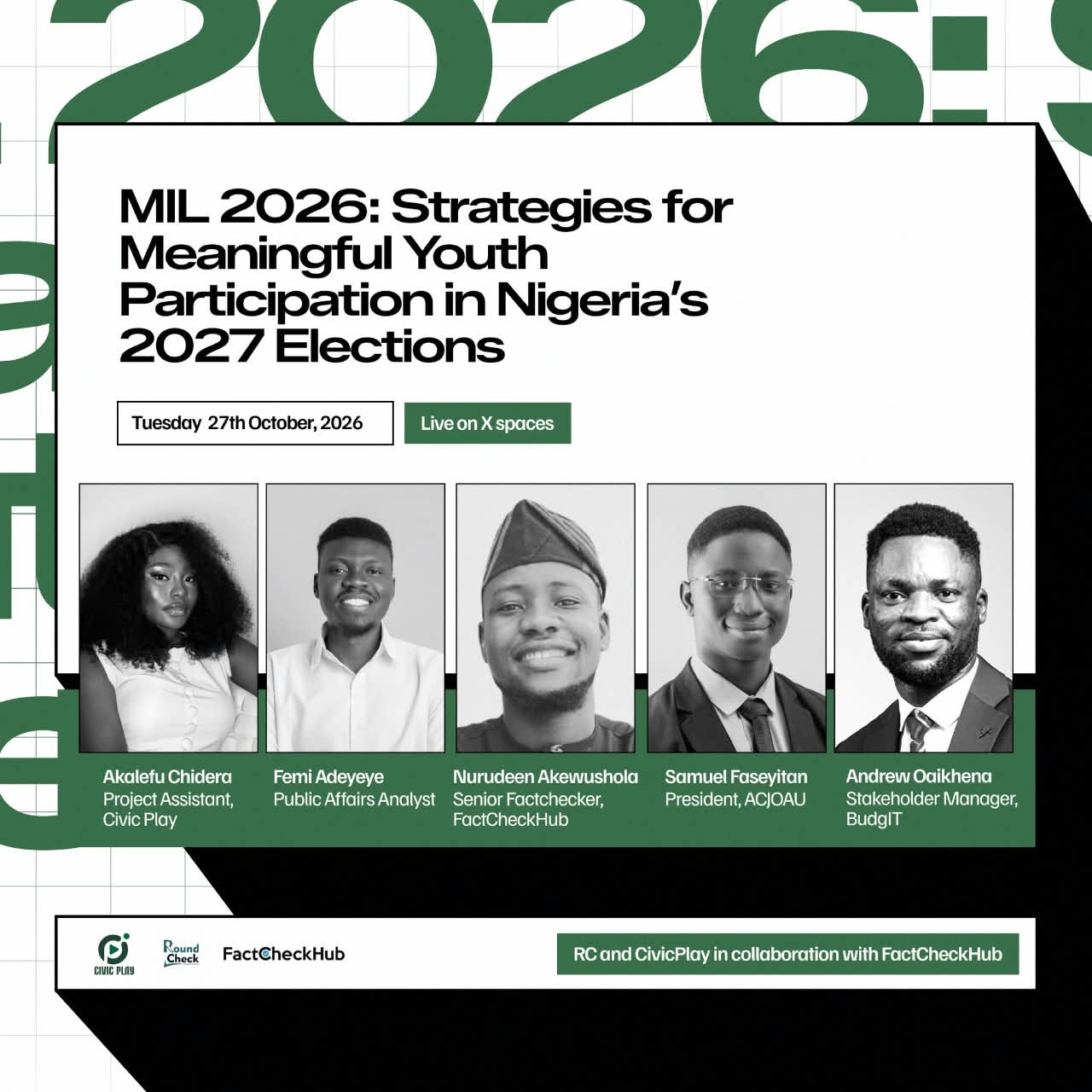
As Nigeria prepares for the 2027 general elections, speakers at ROUNDCHECK’s X Spaces titled “MIL 2026: Strategies for Meaningful Youth Participation in Nigeria’s 2027 Elections”, in collaboration with Civic Play and FactCheckHub, have called for more sustained engagement in the political process, warning that financial barriers, party structures and misinformation continue to limit young people’s influence in the country’s democracy.
Data from the International Institute for Democracy and Electoral Assistance (International IDEA) put overall voter turnout at 43.65 percent in 2015, 34.75 percent in 2019 and 26.71 percent in 2023.
The discussion examined how young Nigerians can participate more meaningfully in the electoral process, the barriers that prevent them from translating political interest into influence, and the role of civic education and media literacy in strengthening democratic participation.
Contributors included Femi Adeyeye, a public affairs analyst; Nurudeen Akewushola, Senior Factchecker at FactCheckHub; Samuel Faseyitan, President of the Association of Campus Journalists, Obafemi Awolowo University (ACJOAU); and Andrew Oaikhena, Stakeholder Manager at BudgIT. Akalefu Chidera, Project Assistant at Civic Play, moderated the session.
A recurring concern during the discussion was the gap between young people’s ability to mobilise around political issues and their ability to influence decisions, institutions and electoral outcomes over time.
More Read

Faseyitan pointed to the 2020 #EndSARS protests as a reminder of what collective action can achieve. He argued that unity remains an important lesson for young people seeking political change, while stressing that civic participation should extend beyond protests and election campaigns.
He also highlighted the role of campus journalists in making political processes easier for young people to understand. According to him, student journalists can explain the responsibilities of elected officials, the functions of democratic institutions and the issues voters should consider when assessing candidates.
Expressing concern, he noted that civic awareness alone cannot overcome the barriers young people face when seeking elective office. High nomination fees, patronage, godfatherism and entrenched party structures can make it difficult for new entrants to compete.
Oaikhena argued that meaningful youth participation requires young people to move beyond political mobilisation and become more involved in the decisions that shape governance.
Although the Not Too Young to Run reform of 2018 reduced the constitutional age requirements for several elective offices, it did not remove the financial and institutional barriers confronting aspiring candidates.
The cost of securing party nominations illustrates the challenge. The All Progressives Congress (APC) set the combined cost of its presidential expression-of-interest and nomination forms at ₦100 million. The African Democratic Congress (ADC), in its revised schedule, set the presidential nomination form fee at ₦90 million. Both parties announced concessions for specified categories of aspirants, including young people, although the applicable discounts and conditions differ.
These figures concern party nomination processes, not the total cost of running an election campaign. Nevertheless, they highlight the financial demands facing aspiring candidates before they can compete for votes.
For young people who lack wealthy sponsors, established political connections or access to party networks, such costs can restrict their opportunities to contest for office.
The European Union Election Observation Mission’s final report on Nigeria’s 2023 general elections also identified high nomination fees as a factor that appeared to discourage youth candidacy. While younger candidates featured more prominently in some legislative contests, their representation remained considerably lower in higher-profile offices such as the Senate and governorships.
The challenge, therefore, extends beyond encouraging young people to become interested in politics. It also concerns whether political parties and electoral structures provide realistic opportunities for them to compete.
While the speakers broadly acknowledged the need for greater youth participation, they differed on how young people should organise politically and whether youth identity itself could provide a basis for political action.
Adeyeye challenged the assumption that being young automatically gives a person a distinct political outlook or makes them a suitable representative of other young people.
“Being young is not a political ideology,” Adeyeye said, arguing that age alone does not establish a candidate’s political programme, priorities or commitment to public interest.
His position called for young people to think beyond their shared age group and consider the ideas, organising structures and political alternatives they want to advance. He also criticised the tendency to discuss political change without building the organisations and relationships needed to achieve it.
Adeyeye stressed the importance of organising with affected communities rather than assuming that activists or political actors can speak on behalf of others without their participation.
Akewushola warned that misinformation poses another challenge to meaningful political participation, particularly when false claims influence how citizens understand elections, political institutions and the value of their votes.
He urged young people to avoid becoming sources or distributors of false information, noting that political misinformation can deepen divisions and discourage citizens from participating in the electoral process.
Claims that votes do not count, for instance, can reinforce voter apathy when repeated without evidence or used to dismiss the electoral process altogether.
Akewushola placed media literacy and fact-checking alongside other forms of civic education. He noted that young people need to know not only how to participate in politics but also how to assess political claims, verify information and distinguish evidence from manipulation.



